Shore Capital ​Research LLC
  • Home
  • Us
    • Us
    • Mark Shore Background
    • Contact Us
    • Community
  • Research
    • Research
    • Mkt Notes
    • VSTOXX Articles
    • VIX Articles
    • Most Read Articles
    • Skewing Your Diversification (The Show)
    • Data Center
  • In The Press
  • Links/Books
  • Events
  • Properties
    • Parking Spaces for Sale or Rent
    • Condos for Sale or Rent

NYC quantitative finance event: forced liquidations and the cost of a liquidity premium

1/3/2015

0 Comments

 
Picture
International Association of Quantitative Finance (IAQF) and The Thalesians Present:

Forced Liquidations, Fire Sales, and The Cost of Illiquidity: A Talk by Andrew Weisman

Institutional investors seeking diversification often build portfolios using collections of securities with widely varying characteristics. To facilitate diversification, investors rely on the “common currencies” of reported return, volatility, and correlation, and employ them as inputs to portfolio construction/ optimization models or processes. Investors using this approach are often drawn to investment opportunities that appear to exhibit diversifying properties because of their limited price discovery.

Such opportunities tend to be relatively illiquid when compared to traditional investments. Investors simply take for granted that they receive a “liquidity premium” that compensates them for the lack of liquidity. This presentation examines an intuitive, rigorous method for pricing this cost.

Speaker:
Andrew Weisman is READ MORE

Follow Mark Shore on Twitter, Facebook and Linkedin

Mark Shore has more than 25 years of experience in the futures markets and managed futures, publishes research, consults on alternative investments and conducts educational workshops. www.shorecapmgmt.com 

Mark Shore is also an Adjunct Professor at DePaul University’s Kellstadt Graduate School of Business, where he teaches the only known accredited managed futures course in the country. He is also a Board Member of the Arditti Center for Risk Management at DePaul University.

0 Comments

An analysis of why volatility indexes are relevant

12/28/2014

0 Comments

 
Picture
By Mark Shore
Financial markets are about making decisions in moments of uncertainty. The one certainty one can make is that no one has a crystal ball, nor can anyone predict with certainty what will occur in the future. Although seeking methods to manage portfolio volatility and tail risk may fall out of fashion from time to time based on market sentiment, it should always be utilized as part of the risk management process. Volatility indexes are instruments that may assist in the risk management process.

In the capital markets when participants ask if a product is still relevant is often when the product finds itself out of favor. Sometimes that is when the product is at its lowest point just before it becomes relevant again and back in favor. This was exactly the situation that occurred with volatility indexes during the summer of 2014.

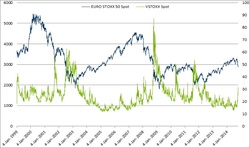
Last July, Japan was reported to be leading the global decline in volatility to the lowest level in seven years. The U.S. market this past summer witnessed the VIX reaching lows not seen since pre-financial crisis days and market participants asking if volatility is too cheap. The VSTOXX® spot index derived from the EURO STOXX 50® Index also found itself near historical lows recently as noted in Chart 2.

Volatility is a function of sentiment: If investors believe the near future is less certain, volatility may increase and the shape of the VSTOXX® Futures curve could move from contango to backwardation. Or if investors are more optimistic for the near future, volatility may decrease. For example:

The Euro Area Sentix Investors Sentiment index turned positive in the fall of 2013 and remained positive until September 2014. The Euro Area Zew Investors Sentiment index has remained positive since January 2013. Although still positive, the Zew index has trended lower since January 2014.

  1. Earlier this year ConvergEx Group released a European Equity Market Structure Survey and asked “How confident are you that the European equity markets could handle the volume created by a sudden geopolitical crisis or other large volatility shock?” 40% were confident, 6% were very confident; 23% not confident and 8% not confident at all. If 54% are less than confident, than seeking various methods to absorb the volatility shock such as VSTOXX® Futures may offer some assistance. But it may be similar to fire insurance; you need to have it before the fire occurs instead of trying to obtain the insurance during the fire.
  2. July 2014 ConvergeEx Group survey of U.S. investors asked the following question “Do you believe investors in the capital markets are too complacent at the moment, given historically low volatility levels?” 66% of the respondents agreed investors are either complacent or much too complacent.
  3. A Forbes article last March mentioned fund managers believe investors were increasing their allocation to European equities and an increased sentiment of economic growth of the Euro area.
  4. The annual Global Sentiment Survey for 2014 conducted by Franklin Templeton Investments found an increased positive sentiment for equity markets. In 2013 55% of the respondents believed their local equity market would be positive. In 2014 62% believed their local equity market would rally. By parsing the survey regionally, the European respondents went from 59% positive in 2013 to 64% in 2014. The North American respondents went from 74% in 2013 to 69% in 2014. The percentage dropped a little in North America, but is still relatively high.

A few interesting points were found READ MORE


Follow Mark Shore on Twitter, Facebook and Linkedin

Copyright ©2014 Mark Shore. Contact Mark Shore for permission for republication at [email protected] Mark Shore has more than 25 years of experience in the futures markets and managed futures, publishes research, consults on alternative investments and conducts educational workshops.www.shorecapmgmt.com 

Mark Shore is also an Adjunct Professor at DePaul University’s Kellstadt Graduate School of Business, where he teaches the only known accredited managed futures course in the country. He is also a Board Member of the Arditti Center for Risk Management at DePaul University.

Past performance is not necessarily indicative of future results.  There is risk of loss when investing in futures and options.  Futures and options can be a volatile and risky investment; only use appropriate risk capital; this investment is not for everyone. The opinions expressed are solely those of the author and are only for educational purposes. Please talk to your financial advisor before making any investment decisions.


0 Comments

VSTOXX volatility behavior when European equities rally

8/21/2014

0 Comments

 
Picture
By  Mark Shore

One of my previous articles “Noisy short-term correlations in global volatility index futures: why trading one regional index futures market may not be enough” discussed the correlations of the VSTOXX® Futures and VIX futures to the EURO STOXX 50® Index. This article is a deeper examination into the behavior of the VSTOXX® spot volatility index when the EURO STOXX 50® Index rallies and is based on 20-day and five-day rolling returns.

It demonstrates potential opportunities for traders and investors to short VSTOXX® Futures when equities rally and/or to reduce or eliminate long positions in the volatility index. However, as noted in the five-day and 20-day rolling returns, VSTOXX® spot on occasion may rally while equities do the same, but it often occurs at turning points of market direction or corrections. This analysis supports the argument of previous research for VSTOXX® maintaining a strong negative correlation to the EURO STOXX 50® Index but the correlation may become less negative during equity rallies. Liquidity is always important to an investor or trader.

How does VSTOXX® behave when equities rally?
The first question examines how VSTOXX® spot behaves when the EURO STOXX 50® Index rallies based on a five-day rolling return. The EURO STOXX 50® spot derived

Read More


Follow Mark Shore on Twitter, Facebook and Linkedin

Copyright ©2014 Mark Shore. Contact Mark Shore for permission for republication at [email protected] Mark Shore has more than 25 years of experience in the futures markets and managed futures, publishes research, consults on alternative investments and conducts educational workshops. www.shorecapmgmt.com 

Mark Shore is also an Adjunct Professor at DePaul University’s Kellstadt Graduate School of Business, where he teaches the only known accredited managed futures course in the country. He is also a Board Member of the Arditti Center for Risk Management at DePaul University.

Past performance is not necessarily indicative of future results. Only use appropriate risk capital; this investment is not for everyone. The opinions expressed are solely those of the author and are only for educational purposes. Please talk to your financial advisor before making any investment decisions.

0 Comments

Skewing Your Diversification Ep 13 w/ Guests Matt Thompson & Mike Thompson Talking Volatility & VIX Futures

7/20/2014

0 Comments

 
Skewing Your Diversification Ep 13 with host Mark Shore and guests Matt Thompson and Mike Thompson from Typhon Capital Management July 20, 2014

Topics include:
Volatility, VIX Futures, asset allocation, S&P500, options, managed futures, hedge funds, ETNs, ETFs, backwardation, contango, portfolio management, risk management and much, much more

Skewing Your Diversification is a weekly internet show hosted by Mark Shore on www.btfd.tv

The show covers many topics of alternatives with a special focus on managed futures, hedge funds, commodities, currencies and futures. Stay tuned for more episodes and lots of great guests!

For a full list of past and upcoming episodes click here

Follow Mark Shore on Twitter, Facebook and Linkedin

Copyright ©2014 Mark Shore. Contact Mark Shore for permission for republication at [email protected] Mark Shore has more than 25 years of experience in the futures markets and managed futures, publishes research, consults on alternative investments and conducts educational workshops. www.shorecapmgmt.com 

Mark Shore is also an Adjunct Professor at DePaul University’s Kellstadt Graduate School of Business, where he teaches the only known accredited managed futures course in the country. He is also a Board Member of the Arditti Center for Risk Management at DePaul University.

Past performance is not necessarily indicative of future results.  There is risk of loss when investing in futures and options.  Futures and options can be a volatile and risky investment; only use appropriate risk capital; this investment is not for everyone. The opinions expressed are solely those of the author and are only for educational purposes. Please talk to your financial advisor before making any investment decisions.
0 Comments

Utilizing European volatility during the current market conditions

6/9/2014

0 Comments

 
Picture
By Mark Shore
The political uncertainty in some Eastern Europe countries caused volatility and stress in the European equity markets. This article examines the recent volatility in the EURO STOXX 50® Index and the corresponding price moves in the VSTOXX® volatility index. Could the VSTOXX® volatility index offer portfolio diversification during these moments of uncertainty? Does it offer a more efficient diversifier for European equity exposure than other volatility indices? This discussion includes two perspectives; the hedger (investor) and the trader.

Liquidity is always important to an investor or trader. Table 1 gives readers an overview of the developments in VSTOXX® Futures liquidity over the last years.

Since last September, the EURO STOXX 50® Index has trended higher. However, READ MORE

Follow Mark Shore on Twitter, Facebook and Linkedin

Copyright ©2014 Mark Shore. Contact Mark Shore for permission for republication at [email protected] Mark Shore has more than 25 years of experience in the futures markets and managed futures, publishes research, consults on alternative investments and conducts educational workshops. www.shorecapmgmt.com 

Mark Shore is also an Adjunct Professor at DePaul University’s Kellstadt Graduate School of Business, where he teaches the only known accredited managed futures course in the country. He is also a Board Member of the Arditti Center for Risk Management at DePaul University.

Past performance is not necessarily indicative of future results. Only use appropriate risk capital; this investment is not for everyone. The opinions expressed are solely those of the author and are only for educational purposes. Please talk to your financial advisor before making any investment decisions.

0 Comments

Characteristics of Peer-to-Peer Lending Loans

5/23/2014

0 Comments

 
PicturePhoto by Mark Shore
By Mark Shore

Understanding the characteristics of a given investment space helps one to understand and appreciate that given space. This article discusses some of the statistics of Peer-to-Peer loans (P2P), thus developing a better understanding of P2P lending.

There is a myth that P2P borrowers are all subprime level borrowers. However as noted in the paper “P2P Lending for Institutional Investors and Wealth Managers: An Overview” not all borrowers are accepted onto a P2P lending platform. Prosper and Lending Club developed standards and policies of vetting and underwriting loans with an estimated 90% rejection rate.1 Prosper and Lending Club tends to concentrate on borrowers with a Fico score of 640 or better, also known as prime and near-prime borrowers.2

Prosper and Lending Club, the two largest P2P U.S. platforms utilize a seven level grade default risk ranking system to determine an appropriate interest rate for the given loan. This is similar to the rating process of banks or investment rating agencies.

According to the Federal Reserve System, the seasonally adjusted charge-off for credit cards averaged READ MORE


Follow Mark Shore on Twitter, Facebook and Linkedin

Copyright ©2014 Mark Shore. Contact Mark Shore for permission for republication at [email protected] Mark Shore has more than 25 years of experience in the futures markets and managed futures, publishes research, consults on alternative investments and conducts educational workshops. www.shorecapmgmt.com 

Mark Shore is also an Adjunct Professor at DePaul University’s Kellstadt Graduate School of Business, where he teaches the only known accredited managed futures course in the country. He is also a Board Member of the Arditti Center for Risk Management at DePaul University.

Past performance is not necessarily indicative of future results. Only use appropriate risk capital; this investment is not for everyone. The opinions expressed are solely those of the author and are only for educational purposes. Please talk to your financial advisor before making any investment decisions.

0 Comments

Chicago PRMIA Volatility Products for Risk Management Event

5/18/2014

0 Comments

 
Picture
Chicago PRMIA (Professional Risk Management International Association) Presents:

Volatility Products for Risk Management

Join Chicago PRMIA for an evening of discussion with experts on volatility products. From research to product application including VIX, VSTOXX and options. Different tools, perspectives and strategies for different applications.

Any questions in advance for the speakers may be emailed to [email protected]

Speakers Include:
Cem Karsan, AEGEA Capital
Mike Kimbarovsky, Advocate Asset Management
Mark Shore, Shore Capital Management / DePaul University

Monday May 19th, 2014

READ MORE


Follow Mark Shore on Twitter, Facebook and Linkedin

Mark Shore has more than 25 years of experience in the futures markets and managed futures, publishes research, consults on alternative investments and conducts educational workshops. www.shorecapmgmt.com 

Mark Shore is also an Adjunct Professor at DePaul University’s Kellstadt Graduate School of Business, where he teaches the only known accredited managed futures course in the country. He is also a Board Member of the Arditti Center for Risk Management at DePaul University.





0 Comments

Skewing Your Diversification Ep. 11 w/ Guest Sabena Arora Discuss Investing in Hotels

5/5/2014

0 Comments

 
Skewing Your Diversification with host Mark Shore and special guest Sabena Arora
May 4, 2014. Topics include:  Hotel Industry, real estate, private equity, NYC, New York City, Hotel Brands, Alternative Investments, franchise, brands, Chicago.

Skewing Your Diversification is a weekly internet show hosted by Mark Shore on www.btfd.tv

The show covers many topics of alternatives with a special focus on managed futures, hedge funds, commodities, currencies and futures. Stay tuned for more episodes and lots of great guests!

For a full list of episodes click here

Follow Mark Shore on Twitter, Facebook and Linkedin

Copyright ©2014 Mark Shore. Contact Mark Shore for permission for republication at [email protected] Mark Shore has more than 25 years of experience in the futures markets and managed futures, publishes research, consults on alternative investments and conducts educational workshops. www.shorecapmgmt.com 

Mark Shore is also an Adjunct Professor at DePaul University’s Kellstadt Graduate School of Business, where he teaches the only known accredited managed futures course in the country. He is also a Board Member of the Arditti Center for Risk Management at DePaul University.
Past performance is not necessarily indicative of future results.  There is risk of loss when investing in futures and options.  Futures and options can be a volatile and risky investment; only use appropriate risk capital; this investment is not for everyone. The opinions expressed are solely those of the author and are only for educational purposes. Please talk to your financial advisor before making any investment decisions.
0 Comments

Skewing Your Diversification with Mark Shore Ep. 10 Allocating to Hedge Funds & Managed Futures

4/20/2014

0 Comments

 
Skewing Your Diversification with host Mark Shore
April 20, 2014. Topics include: Discussing the paper "Skewing Your Diversification" and "Skewing Your Diversification 2013" skewness and kurtosis, asset allocation, managed futures, hedge funds, Sharpe ratio, S-ratio, Sortino ratio, diversification, modern portfolio theory, and much more.

The presentation is based on the paper Skewing Your Diversification and Skewing Your Diversification 2013.

Skewing Your Diversification is a weekly internet show hosted by Mark Shore on www.btfd.tv

The show covers many topics of alternatives with a special focus on managed futures, hedge funds, commodities, currencies and futures. Stay tuned for more episodes and lots of great guests!

For a full list of episodes click here

Follow Mark Shore on Twitter, Facebook and Linkedin

Copyright ©2014 Mark Shore. Contact Mark Shore for permission for republication at [email protected] Mark Shore has more than 25 years of experience in the futures markets and managed futures, publishes research, consults on alternative investments and conducts educational workshops. www.shorecapmgmt.com 

Mark Shore is also an Adjunct Professor at DePaul University’s Kellstadt Graduate School of Business, where he teaches the only known accredited managed futures course in the country. He is also a Board Member of the Arditti Center for Risk Management at DePaul University.

Past performance is not necessarily indicative of future results.  There is risk of loss when investing in futures and options.  Futures and options can be a volatile and risky investment; only use appropriate risk capital; this investment is not for everyone. The opinions expressed are solely those of the author and are only for educational purposes. Please talk to your financial advisor before making any investment decisions.
0 Comments

P2P Lending for Institutional Investors and Wealth Managers: An Overview

4/18/2014

0 Comments

 
Picture
By Mark Shore

P2P lending (or peer-to-peer lending) is a fast growing space in which any individual or organization can lend money directly to another individual through an online p2p lending platform such as Prosper or Lending Club. The transparency, ease-of-use, and ability to quickly make a loan request or fund a loan at competitive interest rates make P2P lending attractive for both borrowers and lenders. The passing of the Jumpstart Our Business Startups or JOBS Act in 2012 created additional interest by formalizing rules around crowd funding—an off shoot of peer-to-peer lending. This growth has attracted institutional and investment advisors to P2P lending to invest in this fast growing space typically through a P2P lending fund. What follows is a look at P2P lending for professional investors.

P2P Lending Industry Overview
In 2013 two of the largest platforms in the United States, Lending Club and Prosper issued READ MORE

Follow Mark Shore on Twitter, Facebook and Linkedin

Copyright ©2014 Mark Shore. Contact Mark Shore for permission for republication at [email protected] Mark Shore has more than 25 years of experience in the futures markets and managed futures, publishes research, consults on alternative investments and conducts educational workshops. www.shorecapmgmt.com 

Mark Shore is also an Adjunct Professor at DePaul University’s Kellstadt Graduate School of Business, where he teaches the only known accredited managed futures course in the country. He is also a Board Member of the Arditti Center for Risk Management at DePaul University.


Past performance is not necessarily indicative of future results. Only use appropriate risk capital; this investment is not for everyone. The opinions expressed are solely those of the author and are only for educational purposes. Please talk to your financial advisor before making any investment decisions.

0 Comments
<<Previous
Forward>>

    The postings on this site are not recommendations for trades and should not be perceived as such. Losses may occur from trading futures and options. Please talk to your financial advisor before trading futures or options. Past performance is no guarantee of future results.

    Proposals for consulting projects may be sent to [email protected]

    Follow @shorecap

    Archives

    January 2018
    September 2017
    August 2017
    July 2017
    June 2017
    May 2017
    March 2017
    January 2017
    December 2016
    November 2016
    October 2016
    August 2016
    July 2016
    June 2016
    May 2016
    March 2016
    January 2016
    October 2015
    September 2015
    August 2015
    July 2015
    June 2015
    April 2015
    March 2015
    February 2015
    January 2015
    December 2014
    October 2014
    September 2014
    August 2014
    July 2014
    June 2014
    May 2014
    April 2014
    March 2014
    February 2014
    January 2014
    December 2013
    November 2013
    October 2013
    September 2013
    August 2013
    July 2013
    June 2013
    May 2013
    March 2013
    February 2013
    January 2013
    December 2012
    November 2012
    October 2012
    September 2012
    August 2012
    July 2012
    June 2012
    April 2012
    March 2012
    February 2012
    January 2012
    December 2011
    November 2011
    September 2011
    August 2011
    July 2011
    April 2011
    March 2011
    February 2011
    January 2011
    December 2010
    October 2010
    September 2010
    August 2010
    June 2010
    May 2010
    April 2010
    March 2010
    February 2010
    January 2010
    December 2009
    September 2009
    August 2009
    July 2009
    June 2009
    May 2009
    April 2009
    March 2009

    Categories

    All
    All
    Asset Allocation
    BTFD.TV
    Commodities
    Community
    Cyber Security
    Due Diligence
    Economic Stats
    Education
    Energy
    Equity
    Events
    Exchange News
    Fintech
    Forex
    Grains
    Hedge Funds
    Managed Futures
    Market Comments
    Metals
    Most Read Articles
    Options
    Other
    P2P Lending
    Portfolio Management
    Press
    Regulation
    Restoring Customer Confidence
    Risk Management
    Skewing Your Diversification (the Show)
    Trading Strategies
    Video
    Vix
    Vstoxx


    RSS Feed

Powered by Create your own unique website with customizable templates.
Photos from dolbinator1000, *PaysImaginaire*, igotphotos, Michele Dorsey Walfred, MojoBaer, Barney A Bishop, renaissancechambara, ShardsOfBlue, Will Merydith, seanmcmenemy, sadatshami, everydayphotos41, Lars Plougmann, ota_photos, Tony Webster, Images_of_Money, ota_photos, bobchin1941, InvestmentTotal.com, christine zenino, reynermedia, charliekwalker, troyjmorris, Michael_Prepelica, theglobalpanorama, Zak Greant, epSos.de, mikebaird, Will Merydith, net_efekt, Gamma Man, Mike Licht, NotionsCapital.com, Lars Plougmann, sully213, WalkingGeek, bgilliard, LendingMemo, orijinal, Visual Content, pfala, Monika Thorpe, CallMeWhatEver, Philip Taylor PT, Rising Damp, Jeff Kubina, Cyron, kees torn, kenteegardin, jeffedoe, One Way Stock, tea610, epSos.de, alexdecarvalho, Frederick Wildman and Sons, Ltd, Nonprofit empowering young women immigrants in NYC, Don Hankins, joiseyshowaa, woodleywonderworks, Skrewtape, firmatography, Christoph Scholz, Charles Haynes, AndreasPoike, Citizen 4474, epicharmus, PinkPersimon, ota_photos, michaeltk, 401(K) 2013, riptheskull, M. Dolly, Davide "Dodo" Oliva, Peter Ciro Photography, Rob Hurson, KimCarpenter NJ, Matt From London, Aardwolf6886, wuestenigel, investmentzen, Walter Rodriguez
