Shore Capital ​Research LLC
  • Home
  • Us
    • Us
    • Mark Shore Background
    • Contact Us
    • Community
  • Research
    • Research
    • Mkt Notes
    • VSTOXX Articles
    • VIX Articles
    • Most Read Articles
    • Skewing Your Diversification (The Show)
    • Data Center
  • In The Press
  • Links/Books
  • Events
  • Properties
    • Parking Spaces for Sale or Rent
    • Condos for Sale or Rent

Managing Volatility - The New Normal Chicago CFA / OIC event 

5/26/2016

0 Comments

 
Picture
CFA Chicago & the Options Industry Council (OIC) Present:

Managing Volatility – The New Normal


This event will feature two panel discussions by industry experts:
Panel 1: The use of options by institutions
Moderator: Joseph F. Burguyne III: OIC
Speakers:
Xerxes K. Bhote: MKM Partners
Stacey Gilbert: Susquehanna Financial Group
April Heitz: DRW Holdings LLC
 
Panel 2: The emergence of volatility as a tradable asset
Moderator: Russell Rhoads: Options Institute at CBOE
Speakers:
Mark Sebastian
Mark Shore: Shore Capital Research LLC & DePaul University
Mike Thompson, CFA: Typhon Capital Management
 
Date:  Wed June 8th
Time: 5pm to 8pm
Venue: Chicago Board of Options Exchange, 400 S. LaSalle Street, Chicago, IL 60605
Reception immediately following
 
For more information and registration click here

0 Comments

Decoding the Myths of Managed Futures 2015 Webinar with Mark Shore

3/23/2016

0 Comments

 
Mark Shore was invited by RJ OASIS to present this educational webinar in January 2016 on his paper "Decoding the Myths of Managed Futures 2015"

To read the full paper click here

Follow Mark Shore on Twitter, Facebook and Linkedin

Mark Shore has more than 25 years of experience in the futures markets and managed futures, publishes research, consults on alternative investments & conducts educational workshops.
www.shorecapmgmt.com email: [email protected]

Mark Shore is also an Adjunct Professor at DePaul University’s Kellstadt Graduate School of Business, where he teaches the only known accredited managed futures course in the country. He is also a Board Member of the Arditti Center for Risk Management at DePaul University.

Past performance is not necessarily indicative of future results. There is risk of loss when investing in futures and options. Futures and options can be a volatile and risky investment; only use appropriate risk capital; this investment is not for everyone. The opinions expressed are solely those of the author and are only for educational purposes. Please talk to your financial advisor before making any investment decisions.


0 Comments

New Research Paper on the CBOE Options-Based Strategy Indexes for the Russell 2000 Index 

3/1/2016

0 Comments

 
Picture
​A new paper by Mark Shore "Analyzing Russell 2000 Options-Based Benchmark Indexes Designed to Provide Enhanced Yields and Risk-Adjusted Returns" was released in Feb, 2015.

This study compared the performances of six options-based strategy indexes to traditional investment indexes. The six options-based strategies, which all write options on the Russell 2000® (RUT) Index, are as follows:
1) BXR – CBOE Russell 2000 BuyWrite Index;
2) CLLR - CBOE Russell 2000 Zero-Cost Put Spread Collar Index;
3) BXRC - CBOE Russell 2000 Conditional BuyWrite Index;
4) BXRD - CBOE Russell 2000 30-Delta BuyWrite Index;
5) PUTR - CBOE Russell 2000 PutWrite Index;
6) WPTR - CBOE Russell 2000 One-Week PutWrite Index.

The following items highlight key results of the study (all analyses were done through the end of 2015):
1) Growth of Options Volume: The average daily contract volume of the Russell 2000® index options traded at the CBOE grew more than 2000% from 2004 to 2015. (Exhibit 1)

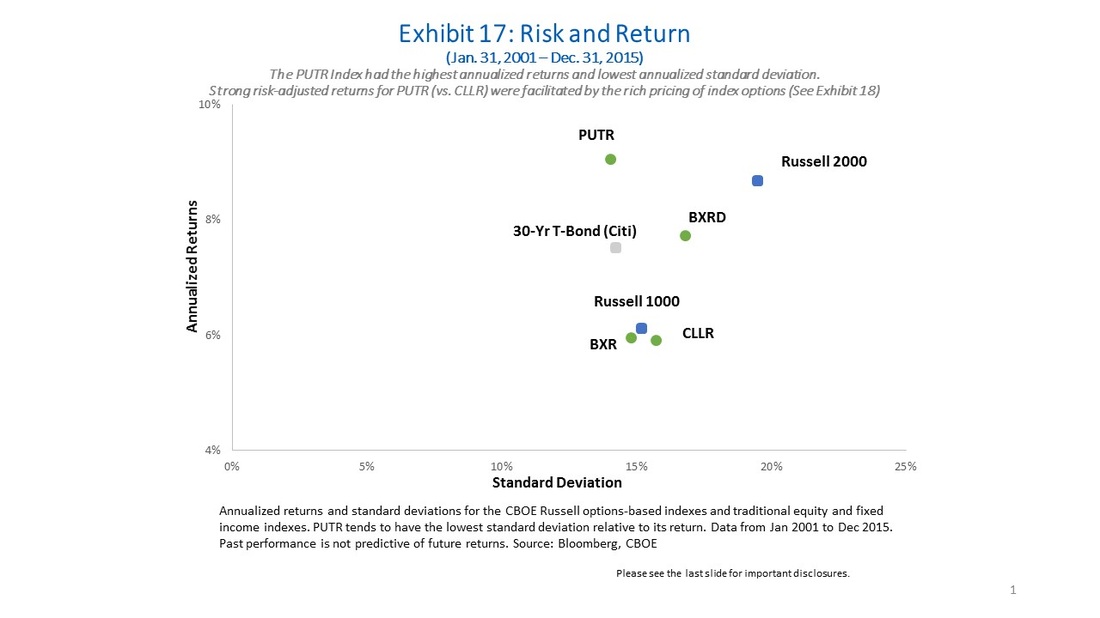
2)Risk-adjusted Returns: Since 2001 the CBOE Russell 2000 PutWrite Index (PUTR) had higher returns, lower volatility and higher Sharpe Ratio than both the Russell 2000 Index and Citigroup 30-Year Treasury Bond Index. (Exhibits 5, 6, 7, and  13)

3) Options Premium Income: In 2015 the aggregate gross premium (as a percentage of the underlying) was 41.4% for the CBOE Russell 2000 One-Week PutWrite Index (WPTR), 22.2% for the CBOE Russell 2000 PutWrite Index (PUTR), 19.5% for the CBOE Russell 2000 BuyWrite Index (BXR), and 9.2% for the CBOE Russell 2000 30-Delta BuyWrite Index (BXRD). (Exhibit 19)

4) Lower Volatility: Since 2001 the PUTR, BXR, CLLR & BXRD indexes had a lower annualized standard deviation than the Russell 2000 Index. The reduction ranged from 14% to 28% lower. The options-based indexes also had lower betas (ranging from 0.59 to 0.82) than the Russell 2000 Index. (Exhibits 7 & 13)

5) Less Maximum Drawdown: Since 2001 the maximum drawdowns for the PUTR, BXR, CLLR & BXRD indexes averaged 21% less than the Russell 2000 Index. (Exhibit 8)

6) Faster Average Recovery (in months): Since 2001 the PUTR Index average recovery time was 21% faster from the drawdown troughs than the Russell 2000 Index. (Exhibit 10)

7) Richly Priced Index Options: Since 2004 the implied volatility for the Russell 2000 has averaged about 2.88 volatility points higher than its realized volatility, and the rich pricing for index options may have facilitated higher returns for option-selling indexes such as PUTR and BXRD (when compared with the CBOE Russell 2000 Zero-Cost Spread Collar Index (CLLR)). (Exhibits 6 and 18)

8) Tail Risk: During the five years when the Russell 2000 return was negative, the PUTR and CLLR indexes had higher returns than the Russell 2000 Index. (Exhibit 26)

Click here for the entire paper

Mark Shore has more than 25 years of experience in the futures markets and managed futures, publishes research, consults on alternative investments & conducts educational workshops.
www.shorecapmgmt.com email: [email protected]

Mark Shore is also an Adjunct Professor at DePaul University’s Kellstadt Graduate School of Business, where he teaches the only known accredited managed futures course in the country. He is also a Board Member of the Arditti Center for Risk Management at DePaul University.

Past performance is not necessarily indicative of future results. There is risk of loss when investing in futures and options. Futures and options can be a volatile and risky investment; only use appropriate risk capital; this investment is not for everyone. The opinions expressed are solely those of the author and are only for educational purposes. Please talk to your financial advisor before making any investment decisions.


0 Comments
0 Comments

Planet Microcap Ep 7 Podcast with Guest Mark Shore Discussing Commodities

9/17/2015

0 Comments

 
Picture
Planet Microcap Ep. 7 - Commodity Futures Market Roundtable with host  Robert Kraft and guests Mark Shore (Shore Capital Research) and Shelly Kraft (StockNewsNow.com).


Click here to listen to the episode

In this episode, the guests cover the following topics:

  • What are the Commodity Futures Markets?
  • How do you buy and sell futures?
  • Is there a correlation between the Commodity Futures Markets and MicroCaps?
  • What is the intrinsic relationship between the Commodity Futures Markets and MicroCaps?
  • How can understanding the Commodity Futures Markets help you when analyzing MicroCap stocks?
  • How the Commodity Futures Markets work
  • Examples, experiences trading on the Commodity Futures Markets
  • History of the Chicago Board of Trade
  • Where to find more information about Commodity Futures Markets
  • For more information about Mark Shore and Shore Capital Research, go to: www.ShoreCapMgmt.com
  • Follow Mark on Twitter @Shorecap
Follow the Planet MicroCap Podcast on Twitter @BobbyKKraft.

Mark Shore has more than 25 years of experience in the futures markets and managed futures, publishes research, consults on alternative investments & conducts educational workshops.
www.shorecapmgmt.com email: [email protected]

Mark Shore is also an Adjunct Professor at DePaul University’s Kellstadt Graduate School of Business, where he teaches the only known accredited managed futures course in the country. He is also a Board Member of the Arditti Center for Risk Management at DePaul University.

Past performance is not necessarily indicative of future results. There is risk of loss when investing in futures and options. Futures and options can be a volatile and risky investment; only use appropriate risk capital; this investment is not for everyone. The opinions expressed are solely those of the author and are only for educational purposes. Please talk to your financial advisor before making any investment decisions.


0 Comments

Advantages of a traditional portfolio allocating to a volatility index

9/2/2015

0 Comments

 
Picture
By Mark Shore

For decades, investors frequently perceived a traditional portfolio allocation in the range of 60 percent equities and 40 percent bonds for proper diversification. Since 2000 investors, both large and small, have experienced several moments of negative returns to their portfolios. This experience has enlightened many investors to seek wider portfolio diversification in attempts to reduce their correlation risk, tail risk and negative volatility.

As investors search for greater diversification, it begs the question, is there an added value to allocate some portion of a traditional portfolio to a volatility index, such as VSTOXX® Futures? Investors often view each component of their portfolio as a standalone investment. Ultimately asset allocation is about how each portfolio component compliments the entire portfolio. Asset allocation should be viewed as a holistic approach to portfolio management.

READ MORE

Follow Mark Shore: 
https://twitter.com/shorecap


Copyright ©2015 Mark Shore. Contact Mark Shore for permission for republication at [email protected] Mark Shore has more than 25 years of experience in the futures markets and managed futures, publishes research, consults on alternative investments and conducts educational workshops.www.shorecapmgmt.com 

Mark Shore is also an Adjunct Professor at DePaul University’s Kellstadt Graduate School of Business, where he teaches the only known accredited managed futures course in the country. He is also a Board Member of the Arditti Center for Risk Management at DePaul University.

Past performance is not necessarily indicative of future results. There is risk of loss when investing in futures and options. Futures and options can be a volatile and risky investment; only use appropriate risk capital; this investment is not for everyone. The opinions expressed are solely those of the author and are only for educational purposes. Please talk to your financial advisor before making any investment decisions.


0 Comments

20 and 60-day rolling correlations between VSTOXX® and VIX tell a deeper story

6/13/2015

0 Comments

 
Picture
By Mark Shore

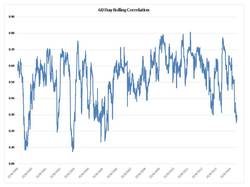
Are the VSTOXX® and VIX indexes becoming less correlated or is it simply natural for the correlation to have wider swings than the tight correlation range that occurred at the height of the financial crisis? This article examines this question by analyzing rolling correlations.

In my previous VSTOXX® articles I discussed the correlation of the VSTOXX® spot index to the VIX spot volatility index and highlighted the difference in correlations prior to the financial crisis versus during the crisis. 

Recently, some volatility market participants have mentioned a possible breakdown in correlation between the two volatility indexes, thus it is an appropriate time to review their correlation. With the divergence in economic activity, U.S. equity market gains and the end of quantitative easing in the U.S. versus the EU’s sovereign debt issue, rate cutting and the declining euro, this begs the question: has the correlation of the volatility indexes recently shifted again?

READ MORE

Follow Mark Shore on Twitter, Facebook and Linkedin

Copyright ©2015 Mark Shore. Contact Mark Shore for permission for republication at [email protected] Mark Shore has more than 25 years of experience in the futures markets and managed futures, publishes research, consults on alternative investments and conducts educational workshops.www.shorecapmgmt.com 

Mark Shore is also an Adjunct Professor at DePaul University’s Kellstadt Graduate School of Business, where he teaches the only known accredited managed futures course in the country. He is also a Board Member of the Arditti Center for Risk Management at DePaul University.

Past performance is not necessarily indicative of future results. There is risk of loss when investing in futures and options. Futures and options can be a volatile and risky investment; only use appropriate risk capital; this investment is not for everyone. The opinions expressed are solely those of the author and are only for educational purposes. Please talk to your financial advisor before making any investment decisions.


0 Comments

Decoding the Myths of Managed Futures 2015

4/20/2015

2 Comments

 
Picture
By Mark Shore

Summary

This paper examines seven very popular myths and misconceptions held by both retail and institutional investors regarding managed futures. This paper updates the original version written in 2011. These myths have persisted for several years. As investors are becoming more aware of the potential use of managed futures for asset allocation and portfolio diversification, knowing if the myths are true or false, is critical for an investor’s understanding and appreciation of managed futures.

Decoding the Myths of Managed Futures 2015

From presenting at more panel events, instructing workshops on alternative investments and teaching my managed futures/ global macro course at DePaul University in the last several years, I found it was time to update the original paper written in 2011 with additional myths added to the list.

The demand for alternative investments continues to grow as investors are seeking more ways to decrease their correlation risk and tail risk of their portfolio. After the dot com bubble and the recession in the early 2000s more investors realized the need for wider diversification beyond stocks and bonds. More recently since the financial crisis the demand to reduce correlation risk and tail risk continues to grow.

Managed futures (AKA Commodity Trading Advisors), a subset of alternative investments and sometimes categorized under global macro hedge funds continues to grow in popularity. However, many old myths still persist about the investment product, the managers and the due diligence of the managers.

As of the end of 2014 assets under management have grown by 736% since 2000 and by 53% since 2008, according to BarclayHedge. 2011, 2012 and 2013 were challenging years for the returns of managed futures and the product found itself out of favor. But no one has a crystal ball to know when markets change and the 2nd half 2014 gave CTAs a positive year while equities were experiencing greater volatility in the later part of 2014. As of March 2015, CTAs continue to profit.

A fair amount of the recent growth in managed futures has been driven by the increasing interest for both commodity related investments as well greater non-correlation of portfolio allocations.

Below are some of the myths and misconceptions of managed futures:

  1. Mysterious "black box" trading systems
  2. Managed futures are a hedge or insurance against equities
  3. Only commodities are traded
  4. Managed futures are risky and volatile
  5. All Commodity Trading Advisors are the same
  6. CTA indices contain survivorship bias
  7. All CTAs are large firms
The discussions below are tendencies of the managed futures industry. Results may vary with individual managers.

1: Mysterious “Black Box” Trading Systems
Over the years I’ve often heard investors or allocators state “we don’t understand or can’t get comfortable with the systematic trading models” and “they are black boxes, so we stay away from them.” Systematic trading models are quantitative computerized trading models. In earlier years, many CTAs were cautious of fully explaining their models due to replication risk. However in more recent years there is a trend towards CTAs explaining their models. But the transparency by the CTA is not enough. It also involves the investors and allocators to do their research in understanding the concepts and terminology of the asset as they do their due diligence, just as they would for any other investment.

2: Hedge or Insurance against Equities
Many believe that managed futures are a hedge or insurance against equities. This is not true. CTAs tend to be non-correlated to equities. This means their returns are independent of equity returns. The independent returns are primarily due to CTAs trading various commodity and financial markets and they can be long, short, neutral or spreading in those markets.

In the last 20 years managed futures have shown moments of having a positive correlation to equities when equities rally and in other moments a negative correlation to equities when equities decline. Over time the correlation cycles between positive and negative. But they tend to show positive performance when there are “shocks” to the various markets or the economy such as in the early 2000’s and in 2008. A CTA does not care about the direction of the market they trade, but only that there is enough of a move to create a profit.

3: Only Commodities Are Traded
Because the managers who trade futures are called Commodity Trading Advisors (CTAs), there is a myth that only commodities are traded. Some CTAs do trade only commodities or only trade one market or sector such as corn or the grain sector. But many trade only financial futures such as stock index futures, bond futures or currency futures or forwards. Diversified CTAs may trade both financial and commodity futures.

4: Managed Futures Are Volatile
Some CTAs can be volatile, just as any other investment has the potential to be volatile or risky. However, if you look at volatility in terms of the Sharpe ratio and or standard deviation than you are also assuming the return distributions are a normal (bell-curve) distribution. CTAs may have low Sharpe ratios, high standard deviations, thus one would believe they are very risky and volatile. However, the low Sharpe ratio and high standard deviation are often derived from positive skewness of the return distribution due to risk management policies.

One must understand the source of volatility returns. Volatility is similar to cholesterol; there is good volatility and bad volatility. Good volatility is derived from positive returns and the bad volatility derived from negative returns. The Sortino ratio and S-ratio are probably more informative in understanding risk-adjusted returns for a non-normal distribution than the Sharpe ratio or standard deviation.

It may sound counter-intuitive, but adding an investment with high a standard deviation may actually reduce the portfolio’s volatility due to the positive skewness. In doing so to analyze the investment not as a standalone investment, but how does it compliment the portfolio.

5: Managed Futures Funds Are All the Same
Some investors will ask “why do I need to invest in more than one CTA? Aren’t all CTAs the same?” The answer to that is NO! This topic can be detailed in a separate discussion, but they are not all the same for some basic reasons: 1) Some CTAs may trade different markets or varying number of markets. 2) Their time horizons or average trade duration may vary. 3) How they get into or out of positions may vary. 4) How they manage risk, one of the most important components of the trading system may vary among the CTAs. As I tell my students at DePaul University, the risk management of the positions may make or break a manager.

6: CTA Indices Contain Survivorship Bias
Some investors will refrain from investing in managed futures because the indices include survivorship bias. They are correct, the indices usually do contain survivorship bias. This bias relates to managers being taken out of the index because they no longer meet a certain requirement to be in the index or they are no longer in business. Managers may also be taken out of an index because they stop reporting to the databases. One common reason for a manager to stop reporting their returns is if they reach a certain asset size and are no longer seeking to raise funds.

What is often missed is that most investment indices do include survivorship bias. For example, General Electric was one of the original components in the Dow Jones index. They are now the only remaining original constituent. Over the decades DJ and S&P have added and removed companies from their respective indices. If survivorship bias is a reason for an investor to avoid investing in managed futures then why isn’t the same logic applied to equities?

7: All CTAs are Large Firms
Often new investors to the managed futures space may know of a few large CTAs and think all CTAs are large firms with hundreds of millions if not billions of dollars under management, millions spent on technology, a large research staff and a deep infrastructure.

However it is more common for a CTA to be a small business. They will often have from 2 to 10 employees. Using easily accessible technology and many back office functions outsourced to third party firms. This shouldn’t take away from investing in the smaller “emerging” managers, but to understand and appreciate the makeup of the industry.

In summary, we have discussed some of the myths or misconceptions that have persisted over the years regarding managed futures. As the industry has become more transparent of their research and demand for non-correlated assets have increased, there is a need for investors to do their research, understand the product, as they would with any other asset class they explore to invest in and understand the profile of the managers they investigate.


Copyright ©2015 Mark Shore. Contact the author for permission for republication at [email protected] Mark Shore publishes research, consults on alternative investments and conducts educational workshops. His research can be found at www.shorecapmgmt.com Mark Shore is also an Adjunct Professor at DePaul University's Kellstadt Graduate School of Business in Chicago where he teaches a managed futures/ global macro course.

Past performance is not necessarily indicative of future results.  There is risk of loss when investing in futures and options.  Always review a complete CTA disclosure document before investing in any Managed Futures program.  Managed futures can be a volatile and risky investment; only use appropriate risk capital; this investment is not for everyone.  The opinions expressed are solely those of the author and are only for educational purposes. Please talk to your financial advisor before making any investment decisions.


2 Comments

NYC quantitative finance event: forced liquidations and the cost of a liquidity premium

1/3/2015

0 Comments

 
Picture
International Association of Quantitative Finance (IAQF) and The Thalesians Present:

Forced Liquidations, Fire Sales, and The Cost of Illiquidity: A Talk by Andrew Weisman

Institutional investors seeking diversification often build portfolios using collections of securities with widely varying characteristics. To facilitate diversification, investors rely on the “common currencies” of reported return, volatility, and correlation, and employ them as inputs to portfolio construction/ optimization models or processes. Investors using this approach are often drawn to investment opportunities that appear to exhibit diversifying properties because of their limited price discovery.

Such opportunities tend to be relatively illiquid when compared to traditional investments. Investors simply take for granted that they receive a “liquidity premium” that compensates them for the lack of liquidity. This presentation examines an intuitive, rigorous method for pricing this cost.

Speaker:
Andrew Weisman is READ MORE

Follow Mark Shore on Twitter, Facebook and Linkedin

Mark Shore has more than 25 years of experience in the futures markets and managed futures, publishes research, consults on alternative investments and conducts educational workshops. www.shorecapmgmt.com 

Mark Shore is also an Adjunct Professor at DePaul University’s Kellstadt Graduate School of Business, where he teaches the only known accredited managed futures course in the country. He is also a Board Member of the Arditti Center for Risk Management at DePaul University.

0 Comments

An analysis of why volatility indexes are relevant

12/28/2014

0 Comments

 
Picture
By Mark Shore
Financial markets are about making decisions in moments of uncertainty. The one certainty one can make is that no one has a crystal ball, nor can anyone predict with certainty what will occur in the future. Although seeking methods to manage portfolio volatility and tail risk may fall out of fashion from time to time based on market sentiment, it should always be utilized as part of the risk management process. Volatility indexes are instruments that may assist in the risk management process.

In the capital markets when participants ask if a product is still relevant is often when the product finds itself out of favor. Sometimes that is when the product is at its lowest point just before it becomes relevant again and back in favor. This was exactly the situation that occurred with volatility indexes during the summer of 2014.

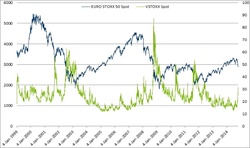
Last July, Japan was reported to be leading the global decline in volatility to the lowest level in seven years. The U.S. market this past summer witnessed the VIX reaching lows not seen since pre-financial crisis days and market participants asking if volatility is too cheap. The VSTOXX® spot index derived from the EURO STOXX 50® Index also found itself near historical lows recently as noted in Chart 2.

Volatility is a function of sentiment: If investors believe the near future is less certain, volatility may increase and the shape of the VSTOXX® Futures curve could move from contango to backwardation. Or if investors are more optimistic for the near future, volatility may decrease. For example:

The Euro Area Sentix Investors Sentiment index turned positive in the fall of 2013 and remained positive until September 2014. The Euro Area Zew Investors Sentiment index has remained positive since January 2013. Although still positive, the Zew index has trended lower since January 2014.

  1. Earlier this year ConvergEx Group released a European Equity Market Structure Survey and asked “How confident are you that the European equity markets could handle the volume created by a sudden geopolitical crisis or other large volatility shock?” 40% were confident, 6% were very confident; 23% not confident and 8% not confident at all. If 54% are less than confident, than seeking various methods to absorb the volatility shock such as VSTOXX® Futures may offer some assistance. But it may be similar to fire insurance; you need to have it before the fire occurs instead of trying to obtain the insurance during the fire.
  2. July 2014 ConvergeEx Group survey of U.S. investors asked the following question “Do you believe investors in the capital markets are too complacent at the moment, given historically low volatility levels?” 66% of the respondents agreed investors are either complacent or much too complacent.
  3. A Forbes article last March mentioned fund managers believe investors were increasing their allocation to European equities and an increased sentiment of economic growth of the Euro area.
  4. The annual Global Sentiment Survey for 2014 conducted by Franklin Templeton Investments found an increased positive sentiment for equity markets. In 2013 55% of the respondents believed their local equity market would be positive. In 2014 62% believed their local equity market would rally. By parsing the survey regionally, the European respondents went from 59% positive in 2013 to 64% in 2014. The North American respondents went from 74% in 2013 to 69% in 2014. The percentage dropped a little in North America, but is still relatively high.

A few interesting points were found READ MORE


Follow Mark Shore on Twitter, Facebook and Linkedin

Copyright ©2014 Mark Shore. Contact Mark Shore for permission for republication at [email protected] Mark Shore has more than 25 years of experience in the futures markets and managed futures, publishes research, consults on alternative investments and conducts educational workshops.www.shorecapmgmt.com 

Mark Shore is also an Adjunct Professor at DePaul University’s Kellstadt Graduate School of Business, where he teaches the only known accredited managed futures course in the country. He is also a Board Member of the Arditti Center for Risk Management at DePaul University.

Past performance is not necessarily indicative of future results.  There is risk of loss when investing in futures and options.  Futures and options can be a volatile and risky investment; only use appropriate risk capital; this investment is not for everyone. The opinions expressed are solely those of the author and are only for educational purposes. Please talk to your financial advisor before making any investment decisions.


0 Comments

Chicago Innovations in Commodity Investing Event

7/30/2014

0 Comments

 
Picture
The Professional Risk Managers' International Association (PRMIA) and CME Group Present

Innovations in Commodity Investing

The discussion will cover changing fundamentals for commodity investors such as backwardation and correlation; new ways to access commodity markets such as ETFs, swaps and futures and other emerging trends in the commodity markets.

This event is sponsored by the CME Group and PRMIA in association with CAIA.

Speakers include:  READ MORE

Follow Mark Shore on Twitter, Facebook and Linkedin

Mark Shore has more than 25 years of experience in the futures markets and managed futures, publishes research, consults on alternative investments and conducts educational workshops. www.shorecapmgmt.com 

Mark Shore is also an Adjunct Professor at DePaul University’s Kellstadt Graduate School of Business, where he teaches the only known accredited managed futures course in the country. He is also a Board Member of the Arditti Center for Risk Management at DePaul University.


0 Comments
<<Previous
Forward>>

    The postings on this site are not recommendations for trades and should not be perceived as such. Losses may occur from trading futures and options. Please talk to your financial advisor before trading futures or options. Past performance is no guarantee of future results.

    Proposals for consulting projects may be sent to [email protected]

    Follow @shorecap

    Archives

    January 2018
    September 2017
    August 2017
    July 2017
    June 2017
    May 2017
    March 2017
    January 2017
    December 2016
    November 2016
    October 2016
    August 2016
    July 2016
    June 2016
    May 2016
    March 2016
    January 2016
    October 2015
    September 2015
    August 2015
    July 2015
    June 2015
    April 2015
    March 2015
    February 2015
    January 2015
    December 2014
    October 2014
    September 2014
    August 2014
    July 2014
    June 2014
    May 2014
    April 2014
    March 2014
    February 2014
    January 2014
    December 2013
    November 2013
    October 2013
    September 2013
    August 2013
    July 2013
    June 2013
    May 2013
    March 2013
    February 2013
    January 2013
    December 2012
    November 2012
    October 2012
    September 2012
    August 2012
    July 2012
    June 2012
    April 2012
    March 2012
    February 2012
    January 2012
    December 2011
    November 2011
    September 2011
    August 2011
    July 2011
    April 2011
    March 2011
    February 2011
    January 2011
    December 2010
    October 2010
    September 2010
    August 2010
    June 2010
    May 2010
    April 2010
    March 2010
    February 2010
    January 2010
    December 2009
    September 2009
    August 2009
    July 2009
    June 2009
    May 2009
    April 2009
    March 2009

    Categories

    All
    All
    Asset Allocation
    BTFD.TV
    Commodities
    Community
    Cyber Security
    Due Diligence
    Economic Stats
    Education
    Energy
    Equity
    Events
    Exchange News
    Fintech
    Forex
    Grains
    Hedge Funds
    Managed Futures
    Market Comments
    Metals
    Most Read Articles
    Options
    Other
    P2P Lending
    Portfolio Management
    Press
    Regulation
    Restoring Customer Confidence
    Risk Management
    Skewing Your Diversification (the Show)
    Trading Strategies
    Video
    Vix
    Vstoxx


    RSS Feed

Powered by Create your own unique website with customizable templates.
Photos from dolbinator1000, *PaysImaginaire*, igotphotos, Michele Dorsey Walfred, MojoBaer, Barney A Bishop, renaissancechambara, ShardsOfBlue, Will Merydith, seanmcmenemy, sadatshami, everydayphotos41, Lars Plougmann, ota_photos, Tony Webster, Images_of_Money, ota_photos, bobchin1941, InvestmentTotal.com, christine zenino, reynermedia, charliekwalker, troyjmorris, Michael_Prepelica, theglobalpanorama, Zak Greant, epSos.de, mikebaird, Will Merydith, net_efekt, Gamma Man, Mike Licht, NotionsCapital.com, Lars Plougmann, sully213, WalkingGeek, bgilliard, LendingMemo, orijinal, Visual Content, pfala, Monika Thorpe, CallMeWhatEver, Philip Taylor PT, Rising Damp, Jeff Kubina, Cyron, kees torn, kenteegardin, jeffedoe, One Way Stock, tea610, epSos.de, alexdecarvalho, Frederick Wildman and Sons, Ltd, Nonprofit empowering young women immigrants in NYC, Don Hankins, joiseyshowaa, woodleywonderworks, Skrewtape, firmatography, Christoph Scholz, Charles Haynes, AndreasPoike, Citizen 4474, epicharmus, PinkPersimon, ota_photos, michaeltk, 401(K) 2013, riptheskull, M. Dolly, Davide "Dodo" Oliva, Peter Ciro Photography, Rob Hurson, KimCarpenter NJ, Matt From London, Aardwolf6886, wuestenigel, investmentzen, Walter Rodriguez