Shore Capital ​Research LLC
  • Home
  • Us
    • Us
    • Mark Shore Background
    • Contact Us
    • Community
  • Research
    • Research
    • Mkt Notes
    • VSTOXX Articles
    • VIX Articles
    • Most Read Articles
    • Skewing Your Diversification (The Show)
    • Data Center
  • In The Press
  • Links/Books
  • Events
  • Properties
    • Parking Spaces for Sale or Rent
    • Condos for Sale or Rent

Chicago PRMIA Volatility Products for Risk Management Event

5/18/2014

0 Comments

 
Picture
Chicago PRMIA (Professional Risk Management International Association) Presents:

Volatility Products for Risk Management

Join Chicago PRMIA for an evening of discussion with experts on volatility products. From research to product application including VIX, VSTOXX and options. Different tools, perspectives and strategies for different applications.

Any questions in advance for the speakers may be emailed to [email protected]

Speakers Include:
Cem Karsan, AEGEA Capital
Mike Kimbarovsky, Advocate Asset Management
Mark Shore, Shore Capital Management / DePaul University

Monday May 19th, 2014

READ MORE


Follow Mark Shore on Twitter, Facebook and Linkedin

Mark Shore has more than 25 years of experience in the futures markets and managed futures, publishes research, consults on alternative investments and conducts educational workshops. www.shorecapmgmt.com 

Mark Shore is also an Adjunct Professor at DePaul University’s Kellstadt Graduate School of Business, where he teaches the only known accredited managed futures course in the country. He is also a Board Member of the Arditti Center for Risk Management at DePaul University.
0 Comments

Skewing Your Diversification Ep. 9 VSTOXX / VIX FuturesĀ  Spread

4/6/2014

0 Comments

 
Skewing Your Diversification with host Mark Shore
April 6, 2014. Topics include: VSTOXX futures, VIX futures, correlations, spreads, CBOE, Eurex, S&P 500, Euro STOXX 50, managed futures, hedge funds and much more.

The presentation is based on the paper "Spreading European and U.S. volatility index futures". Click here to read the paper
.

Skewing Your Diversification is a weekly internet show hosted by Mark Shore on www.btfd.tv

The show covers many topics of alternatives with a special focus on managed futures, hedge funds, commodities, currencies and futures. Stay tuned for more episodes and lots of great guests!

For a full list of episodes click here

Follow Mark Shore on Twitter, Facebook and Linkedin

Copyright ©2014 Mark Shore. Contact Mark Shore for permission for republication at [email protected] Mark Shore has more than 25 years of experience in the futures markets and managed futures, publishes research, consults on alternative investments and conducts educational workshops. www.shorecapmgmt.com 

Mark Shore is also an Adjunct Professor at DePaul University’s Kellstadt Graduate School of Business, where he teaches the only known accredited managed futures course in the country. He is also a Board Member of the Arditti Center for Risk Management at DePaul University.
Past performance is not necessarily indicative of future results.  There is risk of loss when investing in futures and options.  Futures and options can be a volatile and risky investment; only use appropriate risk capital; this investment is not for everyone. The opinions expressed are solely those of the author and are only for educational purposes. Please talk to your financial advisor before making any investment decisions.
0 Comments

Applying the Mass Index for VIX Futures Trading

6/26/2013

2 Comments

 
Picture
By Mark Shore

Our series of trading strategies for the CBOE Volatility Index® (VIX®) futures contract traded on CBOE Futures Exchange, LLC (CFE®), have discussed various VIX futures trading ideas. This article discusses the Mass Index. As the VIX futures tends to be a range bound product, this strategy may be of special interest to our readers as it seeks market turning points.

First let's examine the recent liquidity of CFE. On June 3, 2013, an increased volume of 59% was reported for May 2013 versus May 2012. The volume was 3,220,913 in May 2013 versus 2,022,253 in May 2012.i Year-to-date volume was 16,534,805 for 2013 versus 7,838,325 for 2012, an increase of 111%.

Specific to VIX futures, May 2013 experienced trading volume of 3,212,399, the third highest month, behind March and April 2013 (3,220,977 and 4,056,760 respectively) and 61% higher than May 2012. The month of May was the fourth consecutive month in the contract's history of trading volume exceeding 3 million contracts. In May 2013 the monthly average daily volume was 146,018 versus 90,908 in May 2012, an increase of 61%.

The Mass Index was developed by Donald Dorsey and was initially discussed in the June 1992 issue of Technical Analysis of Stocks and Commodities magazine. The Mass Index seeks to identify trend reversals for overbought and oversold markets. This is measured by the increasing or decreasing of the market's range between high and low prices. The Mass Index will increase as the range increases and will decrease as the range decreases.

The Mass Index is a 25-period moving sum of the ratio of two moving averages. The first average is a 9-period exponentially moving average of the high and the low differential. The second average is a 9-period exponential moving average of the first average. Increasing the sum widens the gap and the Mass Index moves higher.ii

Dorsey refers to the "reversal bulge" as an important Mass Index pattern for a high probability of the market reversing direction. This tends to occur when the Mass Index exceeds 27 and quickly falls below 26.5. To determine the reversal direction of the move, buy if the 9-period exponential moving average of the market is trending down and sell if the 9-period exponential moving average is trending up.iii However, a reversal bulge may be an infrequent occurrence.

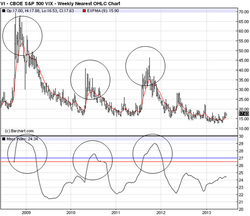
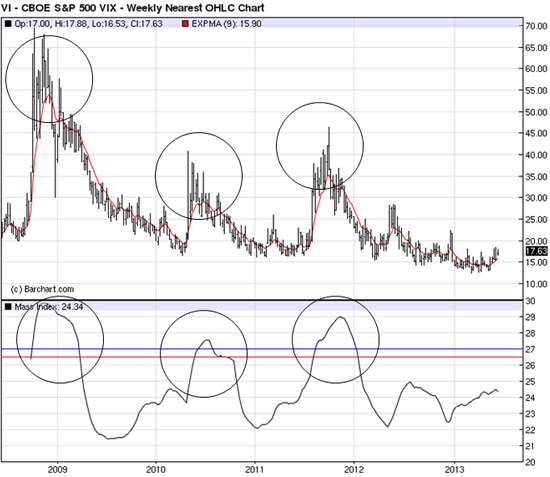
In Chart 1 noted below, the near-term VIX futures contract offers suggests times when the reversal bulge appears. In each case the VIX futures contract was at or near its historical resistance level then began a sell off that lasted several months.

In October 2008 (during the financial crisis) VIX futures reached a high of 69.40 and the Mass Index signaled an overbought market since late September / early October 2008. Between March 23 and March 29, 2009, the reversal bulge appeared as the Mass Index fell below 26.5. The exponential 9-week moving average was higher as the market rallied. This would then be a signal to short VIX futures. This signal lasted into early 2010.

Between July 26, 2010 and Oct 11, 2010, the reversal bulge signal appeared again. The exponential 9-week moving average was signaling a short position. This signal lasted until early or mid 2011.

In the last few months of 2011, the Mass Index indicated an overbought position. During January, the Mass Index signaled a shorting signal for VIX futures. This signal lasted into May or June of 2012. Basis, weekly data and the Mass Index does not offer frequent signals, but they tend to offer signals when the market is overbought and the reversal may last for several months.

Chart 1: VIX Futures Weekly Nearest Futures with a 9 Day Exponential Moving Average and Mass Index, Ending June 18, 2013

Picture
Source: www.barchart.com

Read More
Follow Mark Shore on Twitter, Facebook and Linkedin

i"May 2013 Trading Volume in VIX Futures Post Gains Over a Year Ago" CFE Press Release June 3, 2013
iiwww.barchart.com
iiiAchelis, S. (2001). Technical Analysis from A to Z. New York, McGraw-Hill, 181:183


Copyright ©2013 Mark Shore. Contact the author for permission for republication at [email protected] Mark Shore has more than 20 years of experience in the futures markets and managed futures, publishes research, consults on alternative investments and conducts educational workshops. www.shorecapmgmt.com

Mark Shore is also an Adjunct Professor at DePaul University's Kellstadt Graduate School of Business in Chicago where he teaches a managed futures / global macro course and an Adjunct at the New York Institute of Finance. Mark is a contributing writer to Reuters HedgeWorld.

Past performance is not necessarily indicative of future results.  There is risk of loss when investing in futures and options.  Always review a complete CTA disclosure document before investing in any Managed Futures program.  Managed futures can be a volatile and risky investment; only use appropriate risk capital; this investment is not for everyone.  The opinions expressed are solely those of the author and are only for educational purposes. Please talk to your financial advisor before making any investment decisions.
2 Comments

Utilizing the Commodity Channel Index on VIX Futures

3/29/2013

0 Comments

 
Picture
By Mark Shore

In the continuing series of discussing methods of trading the CBOE Volatility Index® (VIX®) futures contract traded on CBOE Futures Exchange, LLC (CFE®), this article will discuss utilizing the Commodity Channel Index (CCI).

In each article, readers are reminded that the liquidity of a trading instrument is always very important. On March 1, 2013, CFE again reported a continuing trend of increased volume in the VIX futures contract. Specifically, February 2013 was the second consecutive month that achieved record average daily volume, total volume and single-day volume for the VIX futures contract and for CFE.i

The average daily volume (ADV) for the VIX futures contract reached a record 161,176 contracts traded. This was an increase of 141% from February 2012 and an increase of 17% from January of 2013. February 25 and 26, 2013 experienced record volume days of 302,278 and 299,566 contracts traded respectively. This was also the first time that the VIX futures daily volume exceeded 300,000 contracts. The previously single-day record volume of 221,323 contracts was set on January 2, 2013. In February 2013, 3,062,344 VIX futures contracts were traded, representing an increase of 129% from February 2012. February 2013 trading represented a 6% increase from the record of 2,897,739 traded contracts set in January 2013. February 2013 was the sixth consecutive month in which trading exceeding two million VIX futures contracts and it was the first month in which trading exceeded 3 million VIX futures contracts.

The CCI was developed by Donald Lambert and introduced in the October 1980 issue of Commodities magazine (aka Futures magazine). Application of the CCI is not limited to physical commodities and may apply to financial instruments as well. The CCI is a metric of an investment's variance from its statistical mean. The CCI reports high values when a market reaches an extended high price relative to its average price. It will report low values when a market reaches an extended low price relative to its average price. In basic terms, the CCI is an overbought/ oversold indicator.ii

The CCI is based on the premise that all markets have cycles from low to low or high to high. The CCI is calculated by calculating a typical price of the day from the high + low + close and then creating a simple moving average of the typical price. The final equation of the CCI = (typical price – moving average)/ (0.015* mean deviation). Lambert applies a constant of 0.015 to keep 70% to 80% of the CCI value between +100 and -100.iii

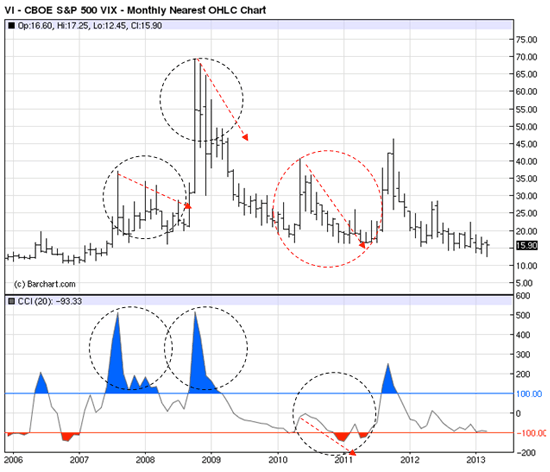
The CCI is considered overbought when the value exceeds +100 and is considered oversold when the value is below -100. However the CCI may extend beyond +100 and -100 and the market could remain overbought/ oversold for an extended period of time. If a market continues to remain overbought/ oversold, but the CCI is reversing (divergence appears) it may imply the market is nearing a correction. Some examples of divergence are provided in this article.

Parameters of the CCI are based on cyclical periods of the market. For this article we assumed a 60 day cycle, using a 20 day (1/3 of the cycle) CCI parameter setting. The lower the parameter setting, the greater the probability of the CCI to reach overbought/ oversold values.

Chart 1: Nearest Monthly VIX Futures Chart, 20 Month CCI

Picture
READ MORE

i"Trading Volume in VIX Futures reaches New All-Time High for Second Consecutive Month", March 1, 2013, CFE Press Release

iiAchelis, S. (2001). Technical Analysis from A to Z. New York, McGraw-Hill, 103:106

iiiwww.barchart.com


Copyright ©2013 Mark Shore. Contact the author for permission for republication at [email protected] Mark Shore has more than 20 years of experience in the futures markets and managed futures, publishes research, consults on alternative investments and conducts educational workshops. www.shorecapmgmt.com

Mark Shore is also an Adjunct Professor at DePaul University's Kellstadt Graduate School of Business in Chicago where he teaches a managed futures / global macro course and an Adjunct at the New York Institute of Finance. Mark is a contributing writer to Reuters HedgeWorld.

Past performance is not necessarily indicative of future results.  There is risk of loss when investing in futures and options.  Always review a complete CTA disclosure document before investing in any Managed Futures program.  Managed futures can be a volatile and risky investment; only use appropriate risk capital; this investment is not for everyone.  The opinions expressed are solely those of the author and are only for educational purposes. Please talk to your financial advisor before making any investment decisions.
0 Comments

Review of 2012 VIX Futures Trading Strategies

1/3/2013

0 Comments

 
Picture
By Mark Shore

In 2012 we discussed methods of trading the CBOE Volatility Index (VIX) futures contract at CBOE Futures Exchange, LLC (CFE). In this article, we will review the previously discussed trading methods and how to apply them to the current market environment.

Liquidity is an important factor for trading. Several times during 2012 VIX futures volume reached record levels including a record high of 2,734,248 contracts in November, Which was a 233% increase from November 2011's 822,017 contracts and which broke the prior trading volume record set in October by 12%. In November the Average Daily Volume for VIX futures was 130,202, an increase of 233% from November 2011. To date, the November VIX futures total volume is 86% higher than it was in 2011 and year-to-date trading volume is 21,344,285 contracts versus 11,455,871 in 2011.i

In past articles we discussed the use of four VIX futures trading strategies: 1) utilizing support and resistance to seek contrarian changes at range bound extremes; 2) crossing of moving averages; 3) utilizing the Aroon Oscillator; and 4) using the True Range to trade VIX futures. In this article the parameters have been set to the same level as they were set in previous articles.

We begin discussing the support and resistance methodology. We originally discussed this in the September 2012 article "VIX Trading Strategies". The VIX futures contract historically tends to find major price support between 10 and 15 and it finds major price resistance around 40 (with the exception of the financial crisis). As you will notice in the monthly chart below VIX futures tend to rally after forming a floor at or near a price of 15. This most recently occurred in 2010 and 2011. During the last several months, the VIX contract has once again found the price of 15 to be major price support area. Could this be the foundation of a floor for a rally in 2013?

Chart 1: Monthly Nearest VIX Futures Chart with Support and Resistance
READ MORE

Copyright ©2012 Mark Shore. Contact the author for permission for republication at [email protected] Mark Shore has more than 20 years of experience in the futures markets and managed futures, publishes research, consults on alternative investments and conducts educational workshops. www.shorecapmgmt.com

Mark Shore is also an Adjunct Professor at DePaul University's Kellstadt Graduate School of Business in Chicago where he teaches a managed futures / global macro course and an Adjunct at the New York Institute of Finance. Mark is a contributing writer to Reuters HedgeWorld.

Past performance is not necessarily indicative of future results.  There is risk of loss when investing in futures and options.  Always review a complete CTA disclosure document before investing in any Managed Futures program.  Managed futures can be a volatile and risky investment; only use appropriate risk capital; this investment is not for everyone.  The opinions expressed are solely those of the author and are only for educational purposes. Please talk to your financial advisor before making any investment decisions.

0 Comments

Trading the True Range of the VIX Futures

11/29/2012

0 Comments

 
Picture
By Mark Shore

Continuing the series of discussing various methods of trading the CBOE Volatility Index® (VIX®) futures contract at CBOE Futures Exchange, LLC (CFE), we will discuss the utility of the True Range indicator and the Average True Range indicator. In previous articles we discussed the use of spreading, correlations, moving averages and the Aroon indicator as methods of trading VIX futures.

Liquidity is an important factor of risk management. CFE announced on November 1, 2012, record volume in October 2012 for both the VIX futures contract and total volume of the Exchange. VIX futures reached a record 2,443,878 contracts traded in October 2012, a 172% increase from October 2011 and a 2% increase from September 2012. The October 2012 Average Daily Volume was 116,375 contracts, a 172% increase from October 2011 and a decrease of 8% from September 2012. However, the markets were closed for two days in October due to hurricane Sandy.i

In previous articles we discussed VIX futures as a mean-reverting market tending to find major price support between 10 and 15 and major price resistance around 40. However, within this range, market turning points do develop from time to time. The True Range indicator is a method of seeking changes in market momentum.

The True Range indicator and the Average True Range were developed by Welles Wilder, also known for developing the Relative Strength index, Directional Movement and the Parabolic Stop and Reverse. True Range is considered a metric of a market's activity or volatility. Wilder first published the True Range indicator in his 1978 book "New Concepts in Technical Trading Systems". The True Range indicator posits that the higher the number, the more likely the market will change direction. A lower number would indicate a weaker trend or indication of a sideways market. The True Range is defined as the maximum value of the following: 1) today's high to today's low; 2) yesterday's close to today's high; and 3) yesterday's close to today's low. The Average True Range is a moving average of the True Range.

VIX futures are an indicator of S&P 500 Index volatility and True Range is a volatility of the volatility or a second derivative of the READ MORE

Copyright ©2012 Mark Shore. Contact the author for permission for republication at [email protected] Mark Shore has more than 20 years of experience in the futures markets and managed futures, publishes research, consults on alternative investments and conducts educational workshops. www.shorecapmgmt.com

Mark Shore is also an Adjunct Professor at DePaul University's Kellstadt Graduate School of Business in Chicago where he teaches a managed futures / global macro course and an Adjunct at the New York Institute of Finance. Mark is a contributing writer to Reuters HedgeWorld.

Past performance is not necessarily indicative of future results.  There is risk of loss when investing in futures and options.  Always review a complete CTA disclosure document before investing in any Managed Futures program.  Managed futures can be a volatile and risky investment; only use appropriate risk capital; this investment is not for everyone.  The opinions expressed are solely those of the author and are only for educational purposes. Please talk to your financial advisor before making any investment decisions.

0 Comments

Trading VIX Futures with the Aroon Oscillator

11/1/2012

0 Comments

 
By Mark Shore

In the September 2012 newsletter, the article "VIX Trading Strategies" was the first in a series discussing various technical and quantitative trading strategies beginning with a simple moving average approach to trading the CBOE Volatility Index (VIX) VIX futures contract. This article discusses the use of the Aroon Oscillator.

The VIX futures contract tends to be mean-reverting, thus seeking overbought conditions is a logical approach to trading this market. As we noted in the previous article, VIX futures tends to trade between a major resistance near 40 and a major support of 10 to 15, and within that the market may trend.

Developing trading strategies involves the investigation of a market's liquidity for various reasons, including the potential for slippage. On October 1, 2012, CBOE Futures Exchange, LLC (CFE) once again reported record volume in VIX futures. In September 2012 the Average Daily Volume reached a new record of 126,345 contracts versus the previous record of 102,587 contracts traded in June 2012. A new record was set in September 2012 of 2,400,552 contracts traded surpassing the previous record of 2,154,325 contracts traded in June 2012. i

For those not familiar with the Aroon Oscillator, it was developed by Tushar Chande in 1995. The oscillator first appeared in the September 1995 issue of Technical Analysis of Stocks and Commodities magazine. The word "Aroon" is Sanskrit for "dawn's early light", thus seeking changes in a market. The oscillator is the differential between the Aroon Up and the Aroon Down indicators which creates an oscillator indicating a market's strength in a trading range.

It is defined as an oscillator because it ranges between READ MORE

Copyright ©2012 Mark Shore. Contact the author for permission for republication at [email protected] Mark Shore has more than 20 years of experience in the futures markets and managed futures, publishes research, consults on alternative investments and conducts educational workshops. www.shorecapmgmt.com

Mark Shore is also an Adjunct Professor at DePaul University's Kellstadt Graduate School of Business in Chicago where he teaches a managed futures / global macro course and an Adjunct at the New York Institute of Finance. Mark is a contributing writer to Reuters HedgeWorld.

Past performance is not necessarily indicative of future results.  There is risk of loss when investing in futures and options.  Always review a complete CTA disclosure document before investing in any Managed Futures program.  Managed futures can be a volatile and risky investment; only use appropriate risk capital; this investment is not for everyone.  The opinions expressed are solely those of the author and are only for educational purposes. Please talk to your financial advisor before making any investment decisions.
0 Comments

VIX Trading Strategies

9/29/2012

4 Comments

 
By Mark Shore
9/28/12

In the May 2012 newsletter article "Volatility Futures: Relative Strength: A Family of Futures Products", we discussed various methods of trading volatility futures products as spreads or indicators, with some discussion of their basic characteristics.

This article will provide discussion of trading methods for individual volatility futures products. The CBOE Volatility Index® (VIX®) futures contract tends to be mean-reverting and trades within a range bound market.

Excluding the 2008 financial crisis, the VIX level tends to fluctuate between 40 and 10. For liquidity seeking traders, hedgers or managers, the chart below demonstrates the increasing volume and open interest in VIX futures, making it a viable choice for a liquid portfolio.

VIX futures trading volume recently reached a new high on three fronts:

1) In August 2012, the VIX futures average daily volume increased by 4.6% to 83,016 contracts versus August 2011 volume of 79,402 contracts.

2) The total volume year to date trading volume in VIX futures has increased by 59% to 13.7 million contracts versus January through August of 2011 volume of 8.6 million contracts.

3) On September 13, 2012 the VIX futures contract reached a new single-day volume record of 190,081 contracts traded. The previous record was 159,744 contracts traded on June 8, 2012.

In a range bound market, long term directional trading may not work as well as it would in other futures markets. Overbought and oversold indicators may have greater utility value. However in the shorter term (duration of days and weeks), directional trades may offer some value. Read more

Copyright ©2012 Mark Shore. Contact the author for permission for republication at [email protected] Mark Shore has more than 20 years of experience in the futures markets and managed futures, publishes research, consults on alternative investments and conducts educational workshops. www.shorecapmgmt.com

Mark Shore is also an Adjunct Professor at DePaul University's Kellstadt Graduate School of Business in Chicago where he teaches a managed futures / global macro course and an Adjunct at the New York Institute of Finance. Mark is a contributing writer to Reuters HedgeWorld.

Past performance is not necessarily indicative of future results.  There is risk of loss when investing in futures and options.  Always review a complete CTA disclosure document before investing in any Managed Futures program.  Managed futures can be a volatile and risky investment; only use appropriate risk capital; this investment is not for everyone.  The opinions expressed are solely those of the author and are only for educational purposes. Please talk to your financial advisor before making any investment decisions.

4 Comments

Utilizing Dynamic Correlations of the VIX vs the S&P 500

8/7/2012

0 Comments

 
Published July 31, 2012
CBOE Futures Exchange
"Futures in Volatility" Newsletter
By Mark Shore

While analyzing the utility value of the CBOE Volatility Index (VIX) futures® contract relative to the underlying market (S&P 500), a question often arises regarding the correlation of these two instruments. In this article we look at various durations of rolling correlations to determine its utility value.

The "static" correlation of two investment components is often quoted in a correlation matrix table when multiple markets are discussed or if there are only two markets, a single quote.

From January 2004 to June 2012, static correlation of daily VIX end of day data to the S&P 500 is -0.75. However, a static correlation does not always offer a strong profile of correlation. Correlation typically depends on the time duration of a holding period, thus building a profile of that period. One must keep in mind the S&P 500 has a growth component, whereas the VIX is more of a mean reverting market with moments of upward or downward spikes.

Between January 2004 and June 2012, the VIX reached its maximum close of 80.06 on October 27, 2008. It reached a minimum of 9.89 on January 24, 2007. During this period the VIX has averaged 21.08

Read more

Copyright ©2012 Mark Shore. Contact the author for permission for republication at [email protected] Mark Shore has more than 20 years of experience in the futures markets and managed futures, publishes research, consults on alternative investments and conducts educational workshops.

Past performance is not necessarily indicative of future results. There is risk of loss when investing in futures and options. Always review a complete CTA disclosure document before investing in any Managed Futures program. Managed futures can be a volatile and risky investment; only use appropriate risk capital; this investment is not for everyone. The opinions expressed are solely those of the author and are only for educational purposes. Please talk to your financial advisor before making any investment decisions.

0 Comments

Volatility Futures: Relative Strength - A Family of Futures Products

6/10/2012

0 Comments

 
By Mark Shore
CBOE Futures Exchange "Futures In Volatility" Newsletter
May 31,  2012

Many investors are familiar with the CBOE Volatility Index (VIX) that is calculated based on options on the S&P 500 Index option and is an indicator of implied volatility and investor sentiment. But some may not be aware that CBOE Futures ExchangeSM (CFE) lists and trades the VIX futures contract (Ticker symbol: VX).

The popularity of the VX futures contract has grown and the VX futures contract recently experienced its highest trading volume month in March 2012 with 1.96 million contracts traded, which is an 84% increase from a year earlier.

As the popularity of the VX futures contract increases, CFE continues to expand the volatility index franchise to include futures and security futures contracts covering several underlying markets. See the table below for a list of the volatility index futures and security futures that CFE currently offers for trading on its market.

From the retail investor to the institutional investor or money manager such as a Commodity Trading Advisor or hedge fund, there is always the question: "How can an investor utilize these contracts in a portfolio?"

Read more

Copyright ©2012 Mark Shore. Contact the author for permission for republication at [email protected] Mark Shore has more than 20 years of experience in the futures markets and managed futures, publishes research, consults on alternative investments and conducts educational workshops. www.shorecapmgmt.com

Mark Shore is also an Adjunct Professor at DePaul University's Kellstadt Graduate School of Business in Chicago where he teaches a managed futures / global macro course and an Adjunct at the New York Institute of Finance. Mark is a contributing writer to Reuters HedgeWorld and the CBOE Futures Exchange.

Past performance is not necessarily indicative of future results.  There is risk of loss when investing in futures and options.  Always review a complete CTA disclosure document before investing in any Managed Futures program.  Managed futures can be a volatile and risky investment; only use appropriate risk capital; this investment is not for everyone.  The opinions expressed are solely those of the author and are only for educational purposes. Please talk to your financial advisor before making any investment decisions.


0 Comments
Forward>>

    The postings on this site are not recommendations for trades and should not be perceived as such. Losses may occur from trading futures and options. Please talk to your financial advisor before trading futures or options. Past performance is no guarantee of future results.

    Proposals for consulting projects may be sent to [email protected]

    Follow @shorecap

    Archives

    January 2018
    September 2017
    August 2017
    July 2017
    June 2017
    May 2017
    March 2017
    January 2017
    December 2016
    November 2016
    October 2016
    August 2016
    July 2016
    June 2016
    May 2016
    March 2016
    January 2016
    October 2015
    September 2015
    August 2015
    July 2015
    June 2015
    April 2015
    March 2015
    February 2015
    January 2015
    December 2014
    October 2014
    September 2014
    August 2014
    July 2014
    June 2014
    May 2014
    April 2014
    March 2014
    February 2014
    January 2014
    December 2013
    November 2013
    October 2013
    September 2013
    August 2013
    July 2013
    June 2013
    May 2013
    March 2013
    February 2013
    January 2013
    December 2012
    November 2012
    October 2012
    September 2012
    August 2012
    July 2012
    June 2012
    April 2012
    March 2012
    February 2012
    January 2012
    December 2011
    November 2011
    September 2011
    August 2011
    July 2011
    April 2011
    March 2011
    February 2011
    January 2011
    December 2010
    October 2010
    September 2010
    August 2010
    June 2010
    May 2010
    April 2010
    March 2010
    February 2010
    January 2010
    December 2009
    September 2009
    August 2009
    July 2009
    June 2009
    May 2009
    April 2009
    March 2009

    Categories

    All
    All
    Asset Allocation
    BTFD.TV
    Commodities
    Community
    Cyber Security
    Due Diligence
    Economic Stats
    Education
    Energy
    Equity
    Events
    Exchange News
    Fintech
    Forex
    Grains
    Hedge Funds
    Managed Futures
    Market Comments
    Metals
    Most Read Articles
    Options
    Other
    P2P Lending
    Portfolio Management
    Press
    Regulation
    Restoring Customer Confidence
    Risk Management
    Skewing Your Diversification (the Show)
    Trading Strategies
    Video
    Vix
    Vstoxx


    RSS Feed

Powered by Create your own unique website with customizable templates.
Photos from dolbinator1000, *PaysImaginaire*, igotphotos, Michele Dorsey Walfred, MojoBaer, Barney A Bishop, renaissancechambara, ShardsOfBlue, Will Merydith, seanmcmenemy, sadatshami, everydayphotos41, Lars Plougmann, ota_photos, Tony Webster, Images_of_Money, ota_photos, bobchin1941, InvestmentTotal.com, christine zenino, reynermedia, charliekwalker, troyjmorris, Michael_Prepelica, theglobalpanorama, Zak Greant, epSos.de, mikebaird, Will Merydith, net_efekt, Gamma Man, Mike Licht, NotionsCapital.com, Lars Plougmann, sully213, WalkingGeek, bgilliard, LendingMemo, orijinal, Visual Content, pfala, Monika Thorpe, CallMeWhatEver, Philip Taylor PT, Rising Damp, Jeff Kubina, Cyron, kees torn, kenteegardin, jeffedoe, One Way Stock, tea610, epSos.de, alexdecarvalho, Frederick Wildman and Sons, Ltd, Nonprofit empowering young women immigrants in NYC, Don Hankins, joiseyshowaa, woodleywonderworks, Skrewtape, firmatography, Christoph Scholz, Charles Haynes, AndreasPoike, Citizen 4474, epicharmus, PinkPersimon, ota_photos, michaeltk, 401(K) 2013, riptheskull, M. Dolly, Davide "Dodo" Oliva, Peter Ciro Photography, Rob Hurson, KimCarpenter NJ, Matt From London, Aardwolf6886, wuestenigel, investmentzen, Walter Rodriguez
