
Shore Capital ​Research LLC
  • Home
  • Us
    • Us
    • Mark Shore Background
    • Contact Us
    • Community
  • Research
    • Research
    • Mkt Notes
    • VSTOXX Articles
    • VIX Articles
    • Most Read Articles
    • Skewing Your Diversification (The Show)
    • Data Center
  • In The Press
  • Links/Books
  • Events
  • Properties
    • Parking Spaces for Sale or Rent
    • Condos for Sale or Rent

Utilizing European volatility during the current market conditions

6/9/2014

0 Comments

 
Picture
By Mark Shore
The political uncertainty in some Eastern Europe countries caused volatility and stress in the European equity markets. This article examines the recent volatility in the EURO STOXX 50® Index and the corresponding price moves in the VSTOXX® volatility index. Could the VSTOXX® volatility index offer portfolio diversification during these moments of uncertainty? Does it offer a more efficient diversifier for European equity exposure than other volatility indices? This discussion includes two perspectives; the hedger (investor) and the trader.

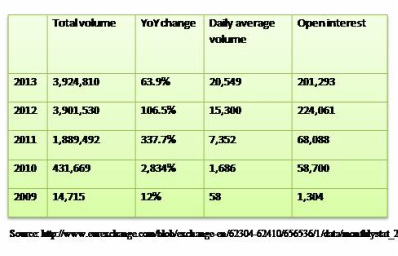
Liquidity is always important to an investor or trader. Table 1 gives readers an overview of the developments in VSTOXX® Futures liquidity over the last years.

Since last September, the EURO STOXX 50® Index has trended higher. However, READ MORE

Follow Mark Shore on Twitter, Facebook and Linkedin

Copyright ©2014 Mark Shore. Contact Mark Shore for permission for republication at [email protected] Mark Shore has more than 25 years of experience in the futures markets and managed futures, publishes research, consults on alternative investments and conducts educational workshops. www.shorecapmgmt.com 

Mark Shore is also an Adjunct Professor at DePaul University’s Kellstadt Graduate School of Business, where he teaches the only known accredited managed futures course in the country. He is also a Board Member of the Arditti Center for Risk Management at DePaul University.

Past performance is not necessarily indicative of future results. Only use appropriate risk capital; this investment is not for everyone. The opinions expressed are solely those of the author and are only for educational purposes. Please talk to your financial advisor before making any investment decisions.


0 Comments

Noisy short-term correlations in global volatility index futures: why trading one regional index futures market may not be enough

3/30/2014

0 Comments

 
Picture
By Mark Shore

Since we have discussed some of the similarities between VSTOXX® Futures and VIX futures including how one can spread the two markets against each other in earlier editions of our newsletter, this article focuses on compelling reasons for utilizing VSTOXX® Futures.

Specifically, we look at a number of different correlation analyses between the VSTOXX® and VIX with the goal of identifying whether VIX exposure provides sufficient coverage for those investors whose portfolios have European exposure. Liquidity is always important to an investor or trader. Table 1 gives readers an overview of the increase in VSTOXX® Futures liquidity over the last years.

One of the most important reasons for utilizing a volatility futures contract is how it behaves in relation to its respective underlying market. VSTOXX® Futures represent the 30-day implied volatility of the downside volatility of the EURO STOXX 50® Index while VIX futures represent the 30-day implied volatility of the downside volatility of the S&P 500 Index.

If one has exposure to European markets or wants to trade the volatility
READ MORE

Copyright ©2014 Mark Shore. Contact Mark Shore for permission for republication at [email protected] Mark Shore has more than 25 years of experience in the futures markets and managed futures, publishes research, consults on alternative investments and conducts educational workshops. www.shorecapmgmt.com 

Mark Shore is also an Adjunct Professor at DePaul University’s Kellstadt Graduate School of Business, where he teaches the only known accredited managed futures course in the country. He is also a Board Member of the Arditti Center for Risk Management at DePaul University.

Past performance is not necessarily indicative of future results.  There is risk of loss when investing in futures and options.  Futures and options can be a volatile and risky investment; only use appropriate risk capital; this investment is not for everyone. The opinions expressed are solely those of the author and are only for educational purposes. Please talk to your financial advisor before making any investment decisions.

0 Comments

A market maker's perspective on European volatility index futures

1/15/2014

1 Comment

 
Picture
By Mark Shore

In this article we speak with Gabriel Manceau, an equity derivatives trader for Barclays Capital and market maker in VSTOXX® Futures. We asked him why European focused volatility products are a logical choice both for those looking to hedge European volatility and to trade the product. An active trader of VSTOXX® Futures, he provides the perspective of someone who sees the flow first hand, and hears the conversation about volatility futures on a daily basis.

Mark Shore: How important are European volatility products for investors and why?

Gabriel Manceau: Europe is one of the most actively traded markets. If investors have European exposure they should definitely be looking at European volatility products such as VSTOXX® Futures. The most precise and relative way to hedge European exposure to volatility is by trading European volatility products.

Mark Shore: Is the market ripe for European volatility products?

Gabriel Manceau: There has been and continues to be an increase of investment capital into Europe. Thus the need for European related volatility products increases alongside this greater exposure for European investments. Since the financial crisis, hedging volatility has become a major theme of risk management for many investors. Therefore the increased demand for European volatility hedging coupled with easy to access volatility products makes the timing “ripe”.

Mark Shore: Can VSTOXX® Futures compliment other financial products? If so, what are a few examples?

Gabriel Manceau: VSTOXX® Futures are the cleanest way to play European volatility, in the sense that READ MORE

Follow Mark Shore on Twitter, Facebook and Linkedin

Copyright ©2014 Mark Shore. Contact Mark Shore for permission for republication at [email protected] Mark Shore has more than 25 years of experience in the futures markets and managed futures, publishes research, consults on alternative investments and conducts educational workshops. www.shorecapmgmt.com 

Mark Shore is also an Adjunct Professor at DePaul University’s Kellstadt Graduate School of Business, where he teaches the only known accredited managed futures course in the country. He is also a Board Member of the Arditti Center for Risk Management at DePaul University.

Past performance is not necessarily indicative of future results.  There is risk of loss when investing in futures and options.  Futures and options can be a volatile and risky investment; only use appropriate risk capital; this investment is not for everyone. The opinions expressed are solely those of the author and are only for educational purposes. Please talk to your financial advisor before making any investment decisions.

1 Comment

Forward curves of European and U.S. volatility index futures

11/5/2013

0 Comments

 
Picture
By Mark Shore

In our last article Spreading European and U.S. volatility index futures, we discussed various points of how investors and traders could utilize spread positions between VSTOXX® Futures contracts traded at Eurex Exchange and VIX futures as a volatility index spread strategy. We thought it was logical to next examine the forward curves or term structures of these two volatility derivatives for similarities and differences with the goal of revealing potential trading opportunities between the two.

This article will examine several issues to present a more complete picture for readers. First, we will look at how each term structure moves under different market conditions. Second, we will present possible trading opportunities related to the differences between the term structures. Third, we will suggest reasons for the contango markets observed in both products. And finally, we will raise additional questions that will be answered in subsequent research.

For investors and traders liquidity is always an important component for trading a market. The liquidity of VSTOXX® Futures continues to increase as noted in Table 1.

To examine the term structures of VSTOXX® Futures and VIX futures, we looked at the average term structure of the two products under the following conditions to determine if the term structure of each changes in different market environments.
READ MORE


Follow Mark Shore on Twitter, Facebook and Linkedin

Copyright ©2013 Mark Shore. Contact the author for permission for republication at [email protected] Mark Shore has more than 25 years of experience in the futures markets and managed futures, publishes research, consults on alternative investments and conducts educational workshops. www.shorecapmgmt.com

Mark Shore is also an Adjunct Professor at DePaul University's Kellstadt Graduate School of Business in Chicago where he teaches a managed futures/ global macro course.  He is a Board Member of Arditti Center of Risk Management at DePaul University and an Adjunct at the New York Institute of Finance. Mark is a contributing writer to Eurex Exchange, Reuters HedgeWorld, CBOE Future Exchange (CFE) and Micro-Cap Review.

Past performance is not necessarily indicative of future results.  There is risk of loss when investing in futures and options.  Futures and options can be a volatile and risky investment; only use appropriate risk capital; this investment is not for everyone. The opinions expressed are solely those of the author and are only for educational purposes. Please talk to your financial advisor before making any investment decisions.



0 Comments

Mark Shore on the growing relevance of European volatility futures

8/20/2013

0 Comments

 
Picture
Euro-denominated volatility for euro-denominated risk

Mark Shore, author of Eurex Exchange’s new volatility newsletter, is an Adjunct Professor and Board Member of the Arditti Center for Risk Management at DePaul University's Kellstadt Graduate School of Business.

Mark founded the consulting/ research firm Shore Capital Management. He is a frequent speaker at alternative investment events and is a contributing writer for a number of publications including Reuters HedgeWorld and Micro-Cap Review.

Mark graduated from DePaul University with a degree in Finance and holds an MBA from the University of Chicago. He spoke with Eurex Exchange about how VSTOXX products fit a market need for volatility products that focus on Europe, and thus help a wide variety of investors increase their hedging accuracy.

Eurex: Why is volatility as an asset class growing in importance?
Shore: Simply put, investors are becoming more aware of market volatility and the need to hedge their portfolios. Unfortunately, many learned tough lessons in the equity markets in the mid to recent past in terms of the tech and housing bubbles and ensuing crashes and the more recent sovereign debt crisis. Volatility in itself is both a positive and negative phenomenon; negative volatility forces investors to take notice. I explain it in simple terms by likening it to cholesterol levels. No one pays attention until they approach dangerous territory.

Eurex: What factors will drive the VSTOXX market going forward?
Shore: First and foremost, ongoing market volatility will drive the future development of the VSTOXX market. As awareness of volatility grows, investors are learning that professional traders are not the only market participants that can use volatility products to better hedge. Education plays an important role in this process. While professional traders can and do utilize volatility products to hedge, smaller investors can access many of the same volatility products, including either by directly taking a view with volatility futures or by way of managed accounts. One important way that volatility as an asset class will gain further traction is through continued educational efforts.

Eurex: Are geopolitical developments causing investors to diversify their volatility portfolios?
Shore: READ MORE


Follow Mark Shore on Twitter, Facebook and Linkedin

Check out our VSTOXX research page

0 Comments

Spreading European and U.S. volatility index futures

8/8/2013

0 Comments

 
Picture
By Mark Shore

In our last article-VSTOXX® Futures: Opportunity for volatility traders with European volatility futures-we introduced the background and several ideas to trade VSTOXX® Futures contracts available at Eurex Exchange. One of the strategies discussed included the VSTOXX®/ VIX spreadstrategy.

As an investor, market liquidity is always an important factor in determining asset allocation within a portfolio. Since 2009 the volume of VSTOXX®Futures continues to increase as noted in Table1.

For a trader or investor already trading VIX futures contracts, adding VSTOXX® Futures to a portfolio should be a relatively easy expansion as both products are gauges of fear and negative volatility for their respective underlying equity markets. If you are new to volatility products or to VSTOXX® Futures, the VSTOXX®/ VIX spread maybe a simple entry into the world of volatility products.

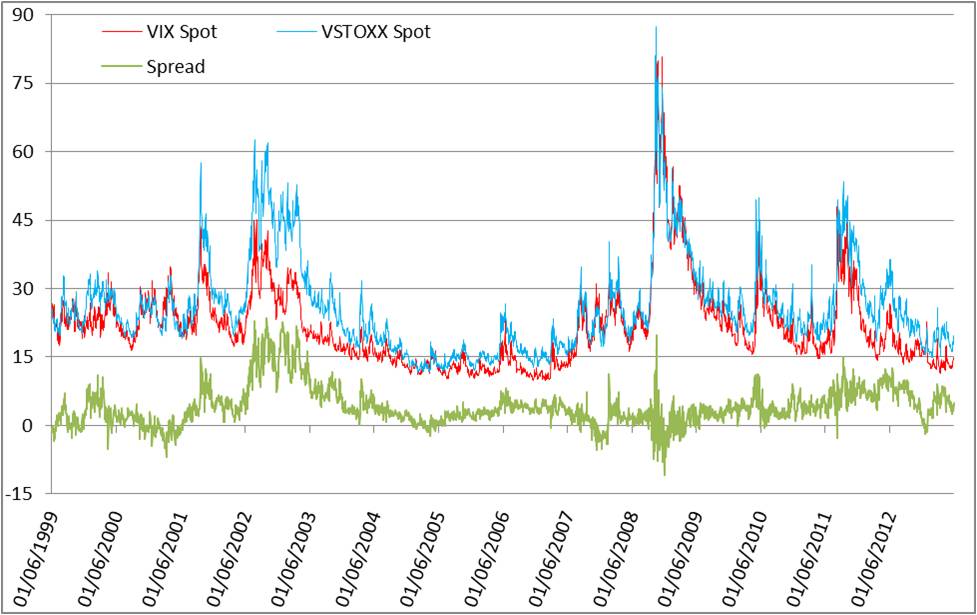
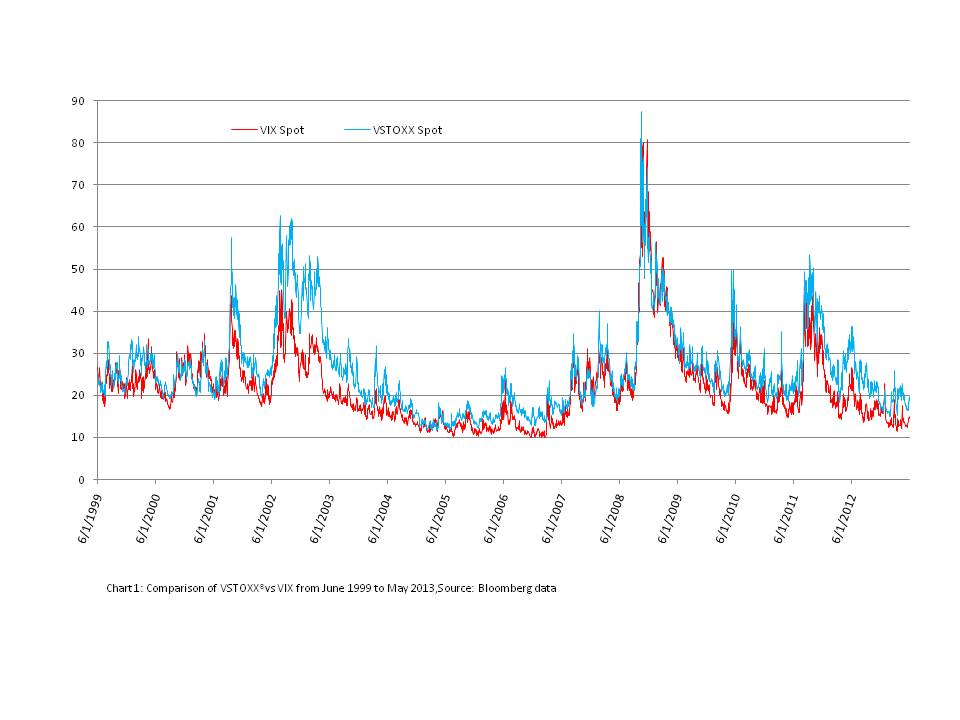
As noted in Chart1, the VSTOXX® historically tends to trade at a premium to the VIX. The data develops a baseline of the spread’s pricing expectations between the two volatility products and when the spread becomes abnormal due to a widening or narrowing spread. Chart1notes that the two volatility products tend to generally move together over the longer-term. Economies have become more interdependent than ever before, thus it is understandable that when there is increased negative volatility in the European equity markets, similar situations may occur in the U.S. equity markets or vice versa. From 1999 to 2013 the daily static correlation of the two products is READ MORE

Follow Mark Shore on Twitter, Facebook and Linkedin

Copyright ©2013 Mark Shore. Contact the author for permission for republication at [email protected] Mark Shore has more than 25 years of experience in the futures markets and managed futures, publishes research, consults on alternative investments and conducts educational workshops. www.shorecapmgmt.com

Mark Shore is also an Adjunct Professor and Board Member of Arditti Center of Risk Management at DePaul University's Kellstadt Graduate School of Business in Chicago where he teaches a managed futures / global macro course and an Adjunct at the New York Institute of Finance. Mark is a contributing writer to Reuters HedgeWorld, CBOE Future Exchange (CFE) and Micro-Cap Review.

Past performance is not necessarily indicative of future results.  There is risk of loss when investing in futures and options.  Futures and options can be a volatile and risky investment; only use appropriate risk capital; this investment is not for everyone. The opinions expressed are solely those of the author and are only for educational purposes. Please talk to your financial advisor before making any investment decisions.
0 Comments

VSTOXX® Futures: Opportunity for volatility traders with European volatility futures

6/27/2013

0 Comments

 
Picture
By Mark Shore

In today’s market environment, volatility is an increasingly important asset class. The benefits of volatility futures contracts are numerous:

-Volatility futures as a sector or asset class may increase a portfolio’s diversification or hedging opportunities.

-It tends to be negatively correlated to stock indexes.

-With contracts like VSTOXX® Futures, which are EUR-denominated volatility futures, an investor with EUR-denominated equity exposure does not have currency risk and exposure. Further, with increased volatility in the Eurozone, VSTOXX® Futures are a targeted way to gain exposure to Europe.

VSTOXX® Futures are listed at Eurex Exchange and are derived from the underlying EURO STOXX 50® Index Options. The increasing demand by investors to reduce portfolio volatility caused the development of volatility futures. The VSTOXX® Future contract is a 30 day forward on the implied volatility of the EURO STOXX 50® Index.

VSTOXX® Futures feature the same benefits of any exchange traded futures contract: 1) Marked-to-Market transparency. 2) Offering liquidity for hedgers and investors (See table 2). 3) Regulated exchange and market. 4) Central clearing of transactions, reducing counter-party default risk. 5) Price discovery of the market. 6) Standardized trading hours and contract specifications. FVS is the VSTOXX® ticker symbol.

For U.S.-based traders and investors, it makes sense to compare the VSTOXX®  and VIX® Indexes from a historical perspective.

To understand the VSTOXX® Index, let’s first define the EURO STOXX 50® Index. The index represents READ MORE

Follow Mark Shore on Twitter, Facebook and Linkedin

Copyright ©2013 Mark Shore. Contact the author for permission for republication at [email protected] Mark Shore has more than 25 years of experience in the futures markets and managed futures, publishes research, consults on alternative investments and conducts educational workshops. www.shorecapmgmt.com

Mark Shore is also an Adjunct Professor at DePaul University's Kellstadt Graduate School of Business in Chicago where he teaches a managed futures / global macro course and an Adjunct at the New York Institute of Finance. Mark is a contributing writer to Reuters HedgeWorld.

Past performance is not necessarily indicative of future results.  There is risk of loss when investing in futures and options.  Futures and options can be a volatile and risky investment; only use appropriate risk capital; this investment is not for everyone. The opinions expressed are solely those of the author and are only for educational purposes. Please talk to your financial advisor before making any investment decisions.

0 Comments

Utilizing the Commodity Channel Index on VIX Futures

3/29/2013

0 Comments

 
Picture
By Mark Shore

In the continuing series of discussing methods of trading the CBOE Volatility Index® (VIX®) futures contract traded on CBOE Futures Exchange, LLC (CFE®), this article will discuss utilizing the Commodity Channel Index (CCI).

In each article, readers are reminded that the liquidity of a trading instrument is always very important. On March 1, 2013, CFE again reported a continuing trend of increased volume in the VIX futures contract. Specifically, February 2013 was the second consecutive month that achieved record average daily volume, total volume and single-day volume for the VIX futures contract and for CFE.i

The average daily volume (ADV) for the VIX futures contract reached a record 161,176 contracts traded. This was an increase of 141% from February 2012 and an increase of 17% from January of 2013. February 25 and 26, 2013 experienced record volume days of 302,278 and 299,566 contracts traded respectively. This was also the first time that the VIX futures daily volume exceeded 300,000 contracts. The previously single-day record volume of 221,323 contracts was set on January 2, 2013. In February 2013, 3,062,344 VIX futures contracts were traded, representing an increase of 129% from February 2012. February 2013 trading represented a 6% increase from the record of 2,897,739 traded contracts set in January 2013. February 2013 was the sixth consecutive month in which trading exceeding two million VIX futures contracts and it was the first month in which trading exceeded 3 million VIX futures contracts.

The CCI was developed by Donald Lambert and introduced in the October 1980 issue of Commodities magazine (aka Futures magazine). Application of the CCI is not limited to physical commodities and may apply to financial instruments as well. The CCI is a metric of an investment's variance from its statistical mean. The CCI reports high values when a market reaches an extended high price relative to its average price. It will report low values when a market reaches an extended low price relative to its average price. In basic terms, the CCI is an overbought/ oversold indicator.ii

The CCI is based on the premise that all markets have cycles from low to low or high to high. The CCI is calculated by calculating a typical price of the day from the high + low + close and then creating a simple moving average of the typical price. The final equation of the CCI = (typical price – moving average)/ (0.015* mean deviation). Lambert applies a constant of 0.015 to keep 70% to 80% of the CCI value between +100 and -100.iii

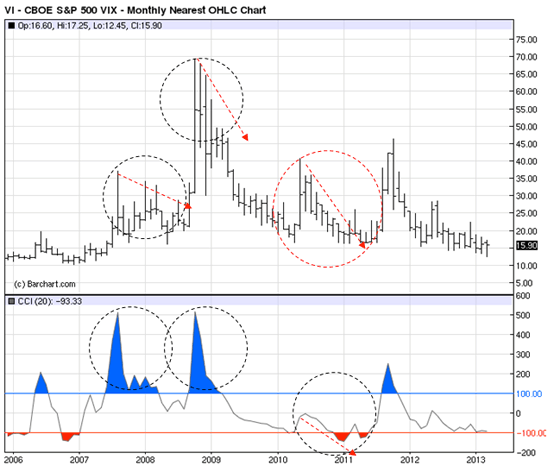
The CCI is considered overbought when the value exceeds +100 and is considered oversold when the value is below -100. However the CCI may extend beyond +100 and -100 and the market could remain overbought/ oversold for an extended period of time. If a market continues to remain overbought/ oversold, but the CCI is reversing (divergence appears) it may imply the market is nearing a correction. Some examples of divergence are provided in this article.

Parameters of the CCI are based on cyclical periods of the market. For this article we assumed a 60 day cycle, using a 20 day (1/3 of the cycle) CCI parameter setting. The lower the parameter setting, the greater the probability of the CCI to reach overbought/ oversold values.

Chart 1: Nearest Monthly VIX Futures Chart, 20 Month CCI

Picture
READ MORE

i"Trading Volume in VIX Futures reaches New All-Time High for Second Consecutive Month", March 1, 2013, CFE Press Release

iiAchelis, S. (2001). Technical Analysis from A to Z. New York, McGraw-Hill, 103:106

iiiwww.barchart.com


Copyright ©2013 Mark Shore. Contact the author for permission for republication at [email protected] Mark Shore has more than 20 years of experience in the futures markets and managed futures, publishes research, consults on alternative investments and conducts educational workshops. www.shorecapmgmt.com

Mark Shore is also an Adjunct Professor at DePaul University's Kellstadt Graduate School of Business in Chicago where he teaches a managed futures / global macro course and an Adjunct at the New York Institute of Finance. Mark is a contributing writer to Reuters HedgeWorld.

Past performance is not necessarily indicative of future results.  There is risk of loss when investing in futures and options.  Always review a complete CTA disclosure document before investing in any Managed Futures program.  Managed futures can be a volatile and risky investment; only use appropriate risk capital; this investment is not for everyone.  The opinions expressed are solely those of the author and are only for educational purposes. Please talk to your financial advisor before making any investment decisions.
0 Comments

Confirmations: Made in China

2/10/2013

0 Comments

 
In the continuing series of "Restoring Customer Confidence" in the futures markets, our friends at Marketswiki.tv produced the below video Confirmations: Made in China.

Gary DeWaal, group general counsel at Newedge, stated the issue caused by Peregrine Financial Group (PFG) ability to avoid regulatory audit checks for more than 20 years. To resolve this issue, in November 2012, the National Futures Association and CME Group hired AlphaMetrix to take on the job of confirming the money FCMs say they have in their segregated accounts, with money that is held at the bank.

This solution is based on the method used by China's futures industry called China Futures Margin Monitoring Center Co. Ltd.(CFMMC).

More Sources:
  • China Futures Margin Monitoring Center Co. Ltd. (CFMMC) on MarketsWiki (link)
  • China System for Protecting Client Cash May Help U.S., NFA Says – Bloomberg (link)
  • NFA and CME Group Select AlphaMetrix to Provide Data Aggregation Services (link)

Past performance is not necessarily indicative of future results.  There is risk of loss when investing in futures and options.  Always review a complete CTA disclosure document before investing in any Managed Futures program. Managed futures can be a volatile and risky investment; only use appropriate risk capital; this investment is not for everyone.  The opinions expressed are solely those of the author and are only for educational purposes. Please talk to your financial advisor before making any investment decisions.


0 Comments

Customer Segregation: A Clear View

1/29/2013

0 Comments

 
In the continuing series of "Restoring Customer Confidence", below is the next video from our friends at Marketswiki.tv.

Byron Baldwin
, SVP, Buyside Relations at Eurex, says his exchange developed segregated account services that can be as wide or granular as needed.

Moving excess customer funds to a clearing house is one way to reduce the amount of capital at risk.


More Sources:
  • Segregated funds (link)
  • CFTC Final Rule: Investment of Customer Funds by Futures Commission Merchants and Derivatives Clearing Organizations, Regulation 1.25 (link)
  • A Layman’s Guide to Regulation 1.25 (link)
  • CFTC Final Rule: Customer Clearing Documentation, Timing of Acceptance for Clearing, and Clearing Member Risk Management (link)
  • Derivatives Clearing Organizations Regulation (link)
  • Boarding the “Wrong Train” – Five Minutes with Gary DeWaal, Newedge (link)
  • Eurex Clearing – Client Asset Protection (link)


Past performance is not necessarily indicative of future results.  There is risk of loss when investing in futures and options.  Always review a complete CTA disclosure document before investing in any Managed Futures program. Managed futures can be a volatile and risky investment; only use appropriate risk capital; this investment is not for everyone.  The opinions expressed are solely those of the author and are only for educational purposes. Please talk to your financial advisor before making any investment decisions.
0 Comments
<<Previous
Forward>>

    The postings on this site are not recommendations for trades and should not be perceived as such. Losses may occur from trading futures and options. Please talk to your financial advisor before trading futures or options. Past performance is no guarantee of future results.

    Proposals for consulting projects may be sent to [email protected]

    Follow @shorecap

    Archives

    January 2018
    September 2017
    August 2017
    July 2017
    June 2017
    May 2017
    March 2017
    January 2017
    December 2016
    November 2016
    October 2016
    August 2016
    July 2016
    June 2016
    May 2016
    March 2016
    January 2016
    October 2015
    September 2015
    August 2015
    July 2015
    June 2015
    April 2015
    March 2015
    February 2015
    January 2015
    December 2014
    October 2014
    September 2014
    August 2014
    July 2014
    June 2014
    May 2014
    April 2014
    March 2014
    February 2014
    January 2014
    December 2013
    November 2013
    October 2013
    September 2013
    August 2013
    July 2013
    June 2013
    May 2013
    March 2013
    February 2013
    January 2013
    December 2012
    November 2012
    October 2012
    September 2012
    August 2012
    July 2012
    June 2012
    April 2012
    March 2012
    February 2012
    January 2012
    December 2011
    November 2011
    September 2011
    August 2011
    July 2011
    April 2011
    March 2011
    February 2011
    January 2011
    December 2010
    October 2010
    September 2010
    August 2010
    June 2010
    May 2010
    April 2010
    March 2010
    February 2010
    January 2010
    December 2009
    September 2009
    August 2009
    July 2009
    June 2009
    May 2009
    April 2009
    March 2009

    Categories

    All
    All
    Asset Allocation
    BTFD.TV
    Commodities
    Community
    Cyber Security
    Due Diligence
    Economic Stats
    Education
    Energy
    Equity
    Events
    Exchange News
    Fintech
    Forex
    Grains
    Hedge Funds
    Managed Futures
    Market Comments
    Metals
    Most Read Articles
    Options
    Other
    P2P Lending
    Portfolio Management
    Press
    Regulation
    Restoring Customer Confidence
    Risk Management
    Skewing Your Diversification (the Show)
    Trading Strategies
    Video
    Vix
    Vstoxx


    RSS Feed

Powered by Create your own unique website with customizable templates.
Photos from dolbinator1000, *PaysImaginaire*, igotphotos, Michele Dorsey Walfred, MojoBaer, Barney A Bishop, renaissancechambara, ShardsOfBlue, Will Merydith, seanmcmenemy, sadatshami, everydayphotos41, Lars Plougmann, ota_photos, Tony Webster, Images_of_Money, ota_photos, bobchin1941, InvestmentTotal.com, christine zenino, reynermedia, charliekwalker, troyjmorris, Michael_Prepelica, theglobalpanorama, Zak Greant, epSos.de, mikebaird, Will Merydith, net_efekt, Gamma Man, Mike Licht, NotionsCapital.com, Lars Plougmann, sully213, WalkingGeek, bgilliard, LendingMemo, orijinal, Visual Content, pfala, Monika Thorpe, CallMeWhatEver, Philip Taylor PT, Rising Damp, Jeff Kubina, Cyron, kees torn, kenteegardin, jeffedoe, One Way Stock, tea610, epSos.de, alexdecarvalho, Frederick Wildman and Sons, Ltd, Nonprofit empowering young women immigrants in NYC, Don Hankins, joiseyshowaa, woodleywonderworks, Skrewtape, firmatography, Christoph Scholz, Charles Haynes, AndreasPoike, Citizen 4474, epicharmus, PinkPersimon, ota_photos, michaeltk, 401(K) 2013, riptheskull, M. Dolly, Davide "Dodo" Oliva, Peter Ciro Photography, Rob Hurson, KimCarpenter NJ, Matt From London, Aardwolf6886, wuestenigel, investmentzen, Walter Rodriguez
